
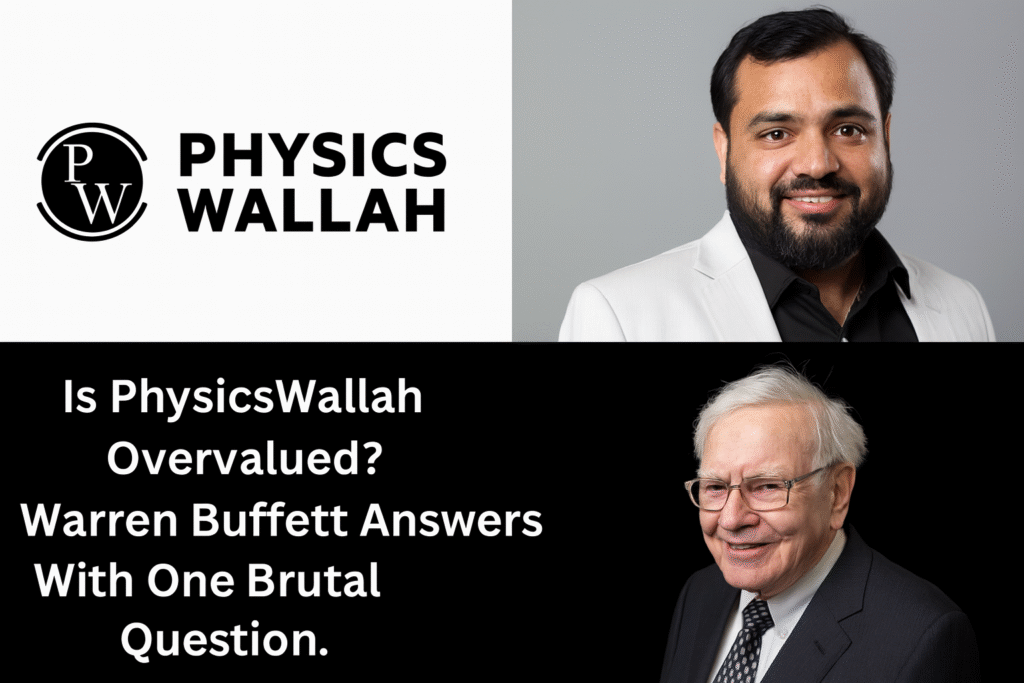
Every bull market creates its own heroes. In 2025, PhysicsWallah became one of them.
A celebrated founder, millions of loyal students, a huge IPO buzz, and a listing-day jump that sent social media into overdrive.
Retail investors rushed in with one overwhelming thought:
“If so many people love this brand, surely the stock must be a goldmine.”
But the stock market doesn’t reward emotions. It rewards clarity.
And nobody brings more clarity to the game of investing than Warren Buffett
If Buffett were sitting across the table while you were staring at PhysicsWallah’s stock price, he wouldn’t give you a lecture.
He’d ask you one brutal question.
Are you paying for the business… or the story?
This is where most investors fall apart.
Buffett’s question isn’t complicated. It’s not mathematical. It doesn’t use jargon.
It cuts straight through the fog of hype and forces you to examine your own thought process.
When you pay a price for a stock, you are either:
- paying for the business — its cashflows, its margins, its economics, or
- paying for the story — the excitement, the trend, the founder’s personality, the noise.
The market is full of people who mistake buzz for value.
PhysicsWallah is a great brand. There’s no debate there.
But a brand is not a moat by itself. Popularity is not a cashflow.
And hype is not a balance sheet.
The job of an investor is not to be impressed.
The job is to be right.
When you ask yourself, “Am I buying the business or the story?” an uncomfortable truth often emerges:
Most people are buying the story.
What future are you paying for?
Buffett never looks at a stock and asks, “What is it today?”
He asks, “What is the market assuming it will become tomorrow?”
This is where valuation becomes real.
At a market cap far above its conservative intrinsic value, you’re not buying the present PhysicsWallah — you’re buying a very optimistic future version of it.
A version where:
- revenues grow smoothly for years
- margins improve dramatically
- offline centres scale flawlessly
- competition never bites
- and students never switch platforms
Is that future impossible?
No.
Is that future guaranteed?
Absolutely not.
And Buffett hates paying for a future that isn’t crystal clear.
His philosophy is brutally simple:
“I don’t pay for dreams. I pay for cashflows.”
If the current valuation assumes a flawless future, then the stock doesn’t have upside — it has expectations.
And expectations are the most dangerous thing a retail investor can buy.
STORY vs BUSINESS — THE REAL DIFFERENCE
Here’s how Buffett sees the world:
A business is something you can explain with numbers.
A story is something you explain with emotions.
When people are excited about a listing-day jump, or a founder’s charisma, or social media love, Buffett smiles — because he has seen this movie before.
Stories burn bright.
Businesses endure.
PhysicsWallah has the potential to be a powerful business. But the stock market is not buying potential — it is pricing certainty. And certainty must be proven through stable, predictable owner earnings, not through brand hype.
If you remove the story and look only at the business, the valuation suddenly looks heavier than people admit.
WHAT THE NUMBERS REVEAL (WITHOUT BORING YOU)
Let’s avoid formulas and keep it simple.
PhysicsWallah generates strong revenue but the market is valuing those revenues at a premium usually reserved for monopolies or deeply moated tech giants.
The IPO pop made everyone excited, but excitement is not an asset class.
Buffett would look at the numbers and calmly say:
“The market is pricing in a future that has not yet arrived.”
And paying today for tomorrow’s perfection has destroyed more wealth than bad businesses ever did.
WHAT BUFFETT WOULD ACTUALLY DO
Buffett would do three things:
First, he’d admire the founder’s journey.
He loves watching entrepreneurs who build something valuable from scratch.
Second, he’d study the business model — offline centres, teacher dependence, retention economics — and wait for a few years of predictable performance.
Third, he would refuse to buy at today’s valuation because there is no margin of safety.
The price is rich, expectations are loaded, and every rupee of future growth is already baked in.
Buffett doesn’t chase the future.
He waits for the future to become the present — and then he buys it at a discount.
THE 10 WORST INVESTING MISTAKES PEOPLE ARE MAKING WITH PW — AND BUFFETT’S ANSWER TO EACH
Spend five minutes online and you’ll find bizarre ideas floating around about this stock.
Here’s how Buffett would respond to the most common ones:
1. “It jumped on listing day — it’ll keep going up.”
Buffett: “Market excitement is not business value.”
2. “Students love it — so the stock is safe.”
Buffett: “Popularity is not profit.”
3. “Offline expansion will automatically boost earnings.”
Buffett: “More branches don’t guarantee more money.”
4. “The founder is smart, so the stock must be smart.”
Buffett: “You’re buying the company, not the person.”
5. “India’s education market is huge, so this will be huge.”
Buffett: “Large industries produce large failures too.”
6. “I’ll sell to someone else at a higher price.”
Buffett: “That’s speculation, not investing.”
7. “It will be the next big edtech giant.”
Buffett: “Compare with success, not collapse.”
8. “Revenue growth means value growth.”
Buffett: “Only earnings matter.”
9. “IPO price was premium, so it must be quality.”
Buffett: “IPO means insiders are selling. Ask yourself why.”
10. “If it falls, I’ll keep averaging down.”
Buffett: “A deeper hole is still a hole.”
Each misconception sounds harmless.
Together, they destroy portfolios.
THE RETAIL INVESTOR TRAP
Retail investors rarely lose money because the business is bad.
They lose money because the price is wrong.
PhysicsWallah might become a fantastic business over time.
But that doesn’t justify paying any price for it today.
Buffett says it best:
“A great company is not a great investment if you pay too high a price.”
When you buy a stock at a price that assumes perfection, you are betting on the company to never slip.
Real companies slip all the time.
THE ONE RULE NEW INVESTORS MUST LIVE BY
If Buffett had to give beginners only one test, it would be this:
“If the stock fell 50% tomorrow, would you still feel proud you bought it?”
If the answer is “No,” then you bought the story, not the business.
Investors who buy stories run away in fear.
Investors who buy businesses sleep peacefully.
FINAL VERDICT
PhysicsWallah is a brand with tremendous influence, a strong mission, and a loyal audience.
But the stock’s valuation is not pricing the present — it is pricing a powerful future that must still be earned.
Buffett wouldn’t hate this company.
In fact, he’d probably admire it.
But he wouldn’t buy it.
Not today.
Not at this price.
Not without seeing years of stable, predictable owner earnings that justify the valuation.
He’d wait.
Watch.
Be patient.
And only buy when the business, not the story, is being offered.
CLOSING THOUGHT
Before buying any hyped stock or hot IPO, sit quietly and ask yourself Buffett’s two brutal questions:
“Am I paying for the business… or the story?”
“What future am I paying for?”
Most of the time, these two answers are enough to save your money — and your peace of mind.
If you found this breakdown useful, you’ll definitely want to read my previous piece where I explained the complete guide to Relative Strength.
Harsh is the creator of Dalal Street Lens, where he writes about investing, market behaviour, and financial psychology in a clear and easy way. He shares insights based on personal experiences, observations, and years of learning how real investors think and make decisions.
Harsh focuses on simplifying complex financial ideas so readers can build better judgment without hype or predictions.
You can reach him at imharshbhojwani@gmail.com
More from Dalal Street Lens
 The ₹242 Bag That Broke India’s Farm Belt
 Pakistan’s Peace Dividend — and India’s Invisible Loss
 Most Investors Misread Accent Microcell. This Is the Real Business.
 Costco Business Model Explained: Why Costco Feels Different the Moment You Walk In
 McDonald’s Business Model Explained: Why It’s Not Really About Burgers
 Jesse Livermore Lessons
 Karnataka Bank Earnings Call Analysis – November 2025
 How Nassim Taleb’s Trading Philosophy Changed the Way I Look at Confidence in Markets
 Retail Investors vs Institutional Investors
Pingback: Retail Investors Are Asking the Wrong Question About Nvidia — Here’s the Right One - dalalstreetlens.in