
1. Introduction
Somewhere between an India-Pakistan match and yet another “Congratulations on your new role!” LinkedIn post, a new national dream took birth:
Financial Freedom Before 35.
This dream spread faster than a Rohit Sharma cover drive GIF.
Suddenly everyone wants to retire early.
People who still Google “difference between mutual fund and SIP” are planning FIRE spreadsheets.
One guy even told his friends, “Bro, I want to retire at 30.”
His salary was Rs 28,000. After PF.
But jokes aside, this dream didn’t appear magically.
It has history, psychology, trauma, FOMO, inflation, and one very emotional Generation.
Today, we explore it all.
Buckle up.
2. What You Will Learn
By the end of this blog, you’ll understand:
- The American origin of the “retire young” fantasy
- Why India imported it without reading terms & conditions
- Why financial freedom before 35 is harder in India
- The traps young earners fall into
- Two brutally honest questions nobody asks
- The emotional truth behind early freedom
- The real Indian definition of financial independence
- A practical roadmap that doesn’t require crypto lottery
- Why money is good, ambition is healthy, and clarity is priceless
3. Table of Contents
- How FIRE Began in the U.S.
- Why Young India Fell in Love With It
- The Reality Check: Why It’s Tougher in India
- The Traps Nobody Warns You About
- Two Crucial Questions Everyone Must Ask
- The Emotional Reality of Freedom
- The Indian Version of Financial Independence
- The Generational Identity Shift
- A Practical Roadmap
- FAQs
- Conclusion
4. How FIRE Started (Spoiler: It Wasn’t Invented on an Instagram Reel)
The FIRE movement —> Financial Independence, Retire Early didn’t start with a bearded YouTuber saying,
“Bro, passive income bana lo.”
It began in 1990s America.
The recipe was simple:
- Start earning at 16
- Save aggressively
- Invest early
- Let compounding do the drum solo
- Retire at 35 and travel in a van eating organic hummus
The math worked because:
- U.S. salaries are high
- U.S. expenses (outside big cities) are manageable
- U.S. markets grow well
- Americans don’t pay dowry, wedding-catering-for-2000, or “Sharmaji ka son bought a Creta” tax
FIRE was about control —
not early retirement, but early autonomy.
India heard the story and said:
“Retire by 35? Challenge accepted.”
Without checking our income-tax slab.
5. Why India Fell in Love With FIRE (And Added Masala)
Young India is a fascinating character:
- raised on scarcity
- exposed to abundance
- trapped between tradition and LinkedIn
- powered by chai, ambition, and anxiety
OF COURSE financial freedom before 35 sounded sexy.
It’s the perfect Bollywood plot:
Middle-class hero vs System
Goal: freedom
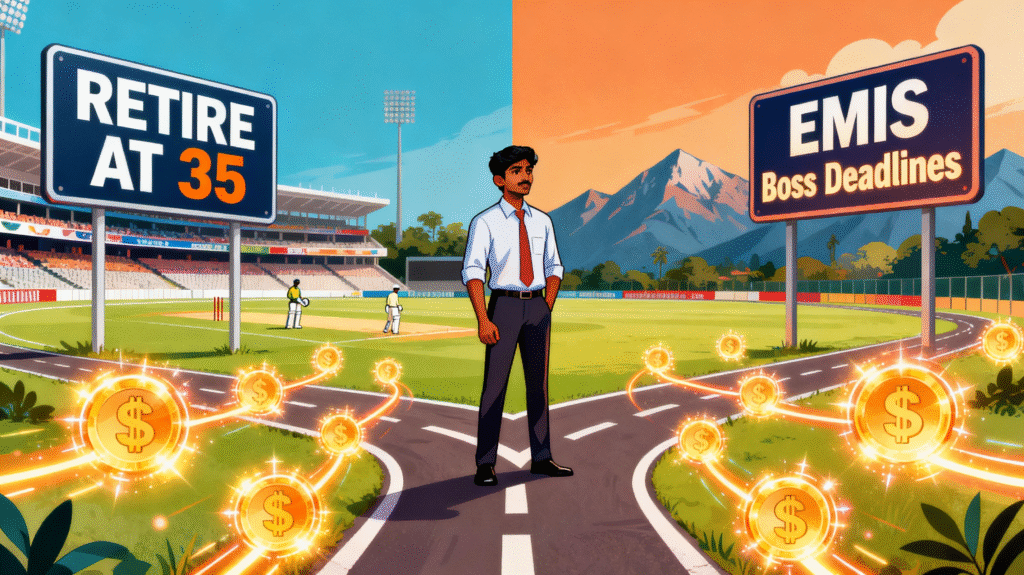
Obstacle: EMIs
Villain: inflation
Comic relief: credit card bill
Climax: SIP calculator
End credits: “Retired at 35” song remix
We also got financially literate earlier:
- Zerodha made investing cool
- YouTube made personal finance accessible
- Instagram made it aspirational
- And comparison made it necessary
Everyone around you seems richer, calmer, and in Bali.
Meanwhile, you’re buying 120-rupee latte without looking at the price only on payday.
Naturally, the dream of early freedom grows.
6. Why Financial Freedom Before 35 Is Tougher in India
Let’s address the elephant in the ATM.
India plays finance on Expert Difficulty Mode.
6.1 Late Start to Earning
Americans start earning at 16.
Indians start at 24.
Sometimes 28.
Sometimes after a second MBA because “placement season mein vibe nahi aaya.”
6.2 Salary vs Cost of Living is a mismatch worthy of a tragic love song
Your salary grows like Test cricket.
Your expenses grow like IPL super over.
6.3 Indian Real Estate = The Great Middle Class Mirage
In America:
House = 3–5× annual salary
In India:
House = Salary × Spouse’s salary × Family’s hopes & dreams × 30-year EMI × 2 ceiling fans free
6.4 Family Expectations
You don’t just earn for yourself.
You earn for:
- parents
- siblings
- random cousin’s education
- Diwali gifting
- society’s approval
Financial freedom in India is a group project nobody told you about.
6.5 Inflation
The ghost that never leaves.
Popcorn was ₹60 yesterday.
It’s ₹300 today.
Next year it will start its own startup.
7. The Traps Young Indians Fall Into
Welcome to the land of Instagram Finance, where dreams go viral and savings go missing.
Trap 1: Passive Income Illusion
People want to “earn while they sleep.”
But they can’t earn while they’re awake.
Trap 2: Shortcut Syndrome
Options trading is not a shortcut.
It is a personality test.
Trap 3: Comparison Paralysis
Someone your age bought a house.
Someone younger bought a BMW.
Someone way younger sold a startup.
Someone even younger is doing toy reviews on YouTube earning crores.
Relax.
Everyone has their own innings.
Trap 4: Mistaking Escape for Freedom
You don’t hate work.
You hate this work.
Trap 5: Identity Crisis
If your identity is built only around your job…
freedom will feel like disconnection.
Trap 6: The “16 Extra Hours” Disaster
Free time is a beautiful concept…
until it arrives.
Then it becomes a staring contest with the ceiling fan.
Trap 7: Emotional Indiscipline
Financial discipline is easy.
Emotional discipline is the final over of an India-Pak match.
8. Two Brutally Honest Questions Everyone Must Ask
These two questions can save years of confusion.
⭐ Question 1:
“If I genuinely liked my life, would I still want to retire at 35?”
Most people don’t want retirement.
They want relief.
Relief from:
- corporate absurdity
- pointless KPIs
- toxic managers
- aimless Zoom calls
- the feeling of being replaceable
This isn’t a money problem.
This is an emotional problem wearing a blazer.
⭐ Question 2:
“What will I do with 16 extra hours every day?”
If you retire at 35 and have no purpose…
Freedom becomes boredom.
Boredom becomes anxiety.
Anxiety becomes depression.
Depression becomes “Let’s start a startup.”
Startup becomes a medium-sized catastrophe.
Purpose is not optional.
It’s oxygen.
9. The Emotional Reality of Freedom
Financial freedom isn’t the destination.
It’s the deletion of noise.
When EMIs stop screaming
and your salary stops controlling your mood
and your boss stops being your weather forecast…
You finally hear your real voice.
Money doesn’t make you someone new.
It makes you who you always were, but couldn’t afford to be.
And freedom isn’t freeing if your mind is not.
You can retire at 35 in Goa,
but if your brain is a chaotic Mumbai local train…
good luck finding peace.
10. The Indian Definition of Financial Independence (The Heart of This Blog)
Forget American FIRE.
Indian financial freedom is:
Not quitting work —
but quitting dependence on ONE income.
One income is fragile.
One income makes you anxious.
One income turns layoffs into disasters.
So the goal is simple:
Build a life where if one income dies, you don’t.
Slowly add:
- skills
- freelance work
- consulting
- dividend income
- small digital assets
- rental income
Not in a hurry.
Not in FOMO.
Not because some influencer screamed “Multiple streams of income, bro!”
You do it to build anti-fragility.
If one tap stops working, the house still gets water.
That is Indian freedom.
That is stability.
That is dignity.
That is power.
11. The Generational Shift Nobody Talks About
Young India is rewriting the rulebook.
11.1 You want control, not laziness
Early freedom isn’t about sitting on a beach.
It’s about not sitting in a meeting that should’ve been an email.
11.2 India starts adulthood late
Education till 22.
Career confusion till 26.
First stable income at 28.
Then suddenly: “Retire in 7 years!”
Of course you’re panicking.
11.3 Success is now personal
Earlier success = IAS or engineering.
Now success = whatever doesn’t drain your soul.
11.4 Money + Meaning > Money Alone
You don’t want to be rich.
You want to be rich and peaceful.
12. The Practical Roadmap (Without the Drama)
Here’s the version that actually works.
✔ Build skills
Your earning power is your real compounding engine.
✔ Build 2–3 income streams slowly
Zero rush.
Zero pressure.
Just steady building.
✔ Keep lifestyle inflation on a leash
Don’t let Zomato eat your FIRE plan.
✔ Invest consistently
Compounding is magic.
But only for people who stay.
✔ Build emotional fitness
The market crashes.
Bosses shout.
Life happens.
Emotional discipline = survival.
✔ Build hobbies, interests, curiosity
This prevents boredom after freedom.
13. FAQs
Q: Is retiring at 35 possible in India?
A: Rare, like a sensible WhatsApp forward.
Q: Is wanting a lot of money bad?
A: No. Want more. Just want wisely.
Q: How many income streams should I build?
A: 2–3 by mid-thirties is ideal.
Q: Is financial freedom anti-work?
A: No. It’s anti-fragility.
14. Conclusion
Financial freedom isn’t quitting your job.
It’s quitting fear.
It’s when life can’t be destroyed by one bad meeting, one boss, one market crash, or one pink slip.
It’s when money supports your identity instead of suffocating it.
It’s when you stop living in survival mode
and start living in you mode.
Make money.
Make lots of it.
But make sure you’re also making a life.
Because financial freedom is not the end.
It’s the beginning of the person you were always meant to become.
If you liked this blog, you might enjoy my previous ones as well:
👉 Why Cheap Stocks Trap You — The Psychology Behind It
👉Why Nifty Is at All Time Highs but Your Portfolio Is in the Basement
👉AI Won’t Crash Like 2000. It Might Correct Like 2008 — When Reality Finally Shows Up.
👉Strong USD Is Not a Modi Issue or a Congress Issue — It’s Global
👉 Why We Feel Smarter After a Stock Falls: The Psychology of Market Regret
👉 Why Comparing Your Portfolio to Others Destroys Your Returns
👉Is Your Stock a Hidden Pump-and-Dump?
Harsh is the creator of Dalal Street Lens, where he writes about investing, market behaviour, and financial psychology in a clear and easy way. He shares insights based on personal experiences, observations, and years of learning how real investors think and make decisions.
Harsh focuses on simplifying complex financial ideas so readers can build better judgment without hype or predictions.
You can reach him at imharshbhojwani@gmail.com
More from Dalal Street Lens
 The ₹242 Bag That Broke India’s Farm Belt
 Pakistan’s Peace Dividend — and India’s Invisible Loss
 Most Investors Misread Accent Microcell. This Is the Real Business.
 Costco Business Model Explained: Why Costco Feels Different the Moment You Walk In
 McDonald’s Business Model Explained: Why It’s Not Really About Burgers
 Jesse Livermore Lessons
 Karnataka Bank Earnings Call Analysis – November 2025
 How Nassim Taleb’s Trading Philosophy Changed the Way I Look at Confidence in Markets
 Retail Investors vs Institutional Investors