

The Standard View of the Costco Business Model
The most common explanation of the Costco business model sounds simple, almost boring.
Costco sells in bulk.
Costco keeps margins low.
Costco compensates with massive volume.
You’ve probably heard this explanation casually from friends, finance videos, or even while standing inside a Costco warehouse yourself. The wide aisles. The giant carts. The oversized packs of everything from toilet paper to olive oil. It all seems designed for one thing: scale.
According to this view, Costco works because it is efficient. Bigger packs mean fewer transactions. Fewer SKUs mean easier inventory management. Lower prices attract more shoppers, which increases volume, which improves supplier terms.
It’s a clean story.
It’s also not wrong.
If you’ve shopped at Costco, this explanation matches what you see and feel. Prices feel fair. Quality feels reliable. And nothing about the store feels wasteful or flashy.
At this stage, there’s no reason to question the model.
Why the Costco Business Model Makes Sense to Customers
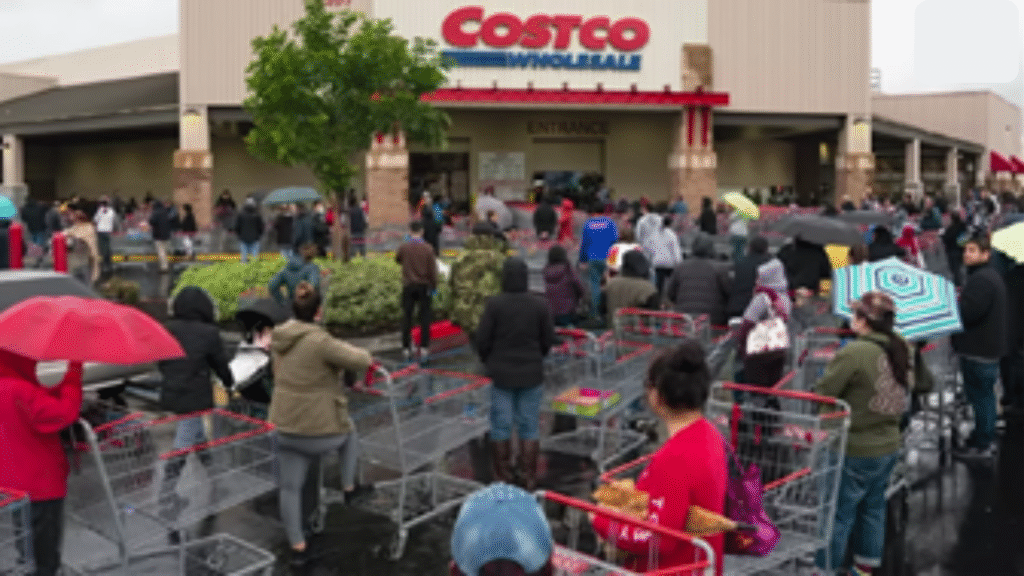
In practice, the Costco business model does work at the surface level.
As a customer, you don’t need spreadsheets to notice it.
You buy batteries once and forget about them for months.
You try a Kirkland product hesitantly — and then buy it again.
You return something without being interrogated or judged.
These are small moments, but they add up.
I’ve stood in Costco return lines where people bring back items with zero friction — sometimes without receipts, sometimes after months — and the transaction ends with a calm “refund issued” instead of suspicion. That alone feels unusual if you’ve shopped anywhere else.
So yes, the standard explanation works locally.
Low prices plus bulk plus efficiency does explain why Costco feels dependable.
So far, the Costco business model holds.
Why the Costco Business Model Still Works at Massive Scale
Now zoom out.
Costco isn’t running one or two warehouses. It’s running hundreds.
Not for a few years — but for decades.
And yet, something strange happens.
Prices don’t quietly creep up.
Quality doesn’t slowly erode.
The return desk doesn’t suddenly get hostile.
If anything, Costco feels unchanged over time.
This is where most retail models break.
At scale, companies usually:
– Add hidden fees
– Expand SKUs recklessly
– Reduce quality to protect margins
But Costco doesn’t behave that way.
Which raises an uncomfortable question.
If the Costco business model is just “low margin + high volume,”
why don’t more scaled retailers feel this stable?
Where Most People Think They’ve Figured Out Costco
At this point, most people conclude:
“Costco just chooses to pass savings to customers.”
It feels satisfying. It fits the evidence. And it doesn’t require deeper thinking.
After all, Costco clearly can raise prices — yet often doesn’t. The famous $1.50 hot dog is still there, decades later, staring at you as you exit with a full cart.
So the story seems complete.
Except it quietly ignores the most important line item in the Costco business model.
The Membership Fee That Changes the Entire Costco Business Model
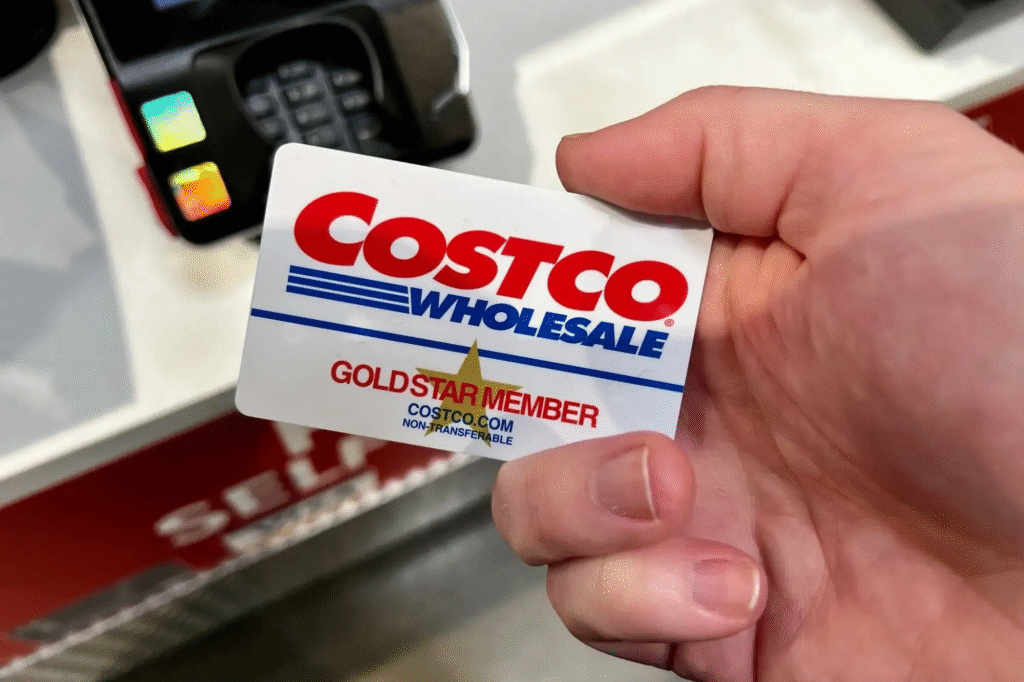
There’s one thing you do at Costco before buying anything.
You pay.
The membership fee is small enough to forget — but powerful enough to change behavior.
Once you’ve paid:
– You stop waiting for discounts
– You stop over-checking prices
– You trust the shelf more than the label
This is the category shift most analyses miss.
Costco Wholesale is not primarily a retailer making money at checkout.
It is a membership business that uses retail as its delivery mechanism.
That changes the entire economics.
Costco earns real profit before the transaction.
The store visit becomes fulfillment, not extraction.
This is why:
– Margins stay capped
– Returns stay generous
– Bad products disappear instead of being discounted
The Costco business model is not about selling better.
It’s about not betraying prepaid trust.
Why Other Companies Fail When Copying the Costco Business Model
Many companies try to imitate Costco.
They introduce loyalty programs.
They launch private labels.
They talk about “everyday value.”
But as customers, we feel the difference almost immediately.
The private label is cheaper — but inconsistent.
The loyalty points expire.
The return desk asks too many questions.
These companies treat membership as a revenue lever.
Costco treats membership as a promise that limits future behavior.
That difference is structural.
Once a company allows itself to quietly exploit customer trust, the Costco-style flywheel breaks. Volume becomes fragile. Customers start checking again.
And once customers start checking, trust is already gone.
The Real Engine of the Costco Business Model
Here’s the part you can’t unsee once you notice it.
Costco doesn’t need to maximize profit per visit
because it already maximized commitment per customer.
That’s why:
– Employees are paid unusually well
– SKUs remain limited
– Quality standards are ruthless
– Price increases are resisted
These aren’t cultural choices.
They’re mechanical necessities of a business that depends on renewal.
The Costco business model survives by making greed structurally inconvenient.
The Costco Business Model in One Line
The Costco business model works because trust is prepaid, and once trust is prepaid, exploitation becomes bad business.
Where the Costco Business Model Could Break
This model isn’t universal.
It works where:
– Quality is observable
– Demand is repeatable
– Customers shop frequently
It would fail in businesses where outcomes are delayed or ambiguous.
The real question isn’t whether Costco’s business model is brilliant.
It’s whether most businesses, or investors — are willing to accept a system that prevents future extraction, even when success makes it tempting.
Costco did.
And that decision still echoes every time a customer pushes a heavy cart through a concrete warehouse and doesn’t feel cheated.
Author context:
I’m drawn to businesses that feel calm to interact with — not because they’re simple, but because their incentives are clean. Costco is one of the few places where the experience never feels adversarial, and that’s worth studying.
Sources used sparingly:
– Costco annual reports (membership revenue, renewal rates)
– Public disclosures on pricing discipline and SKU limits
FINAL TAKEAWAY
The Costco business model doesn’t impress you by being clever.
It wins by being difficult to corrupt.
Harsh is the creator of Dalal Street Lens, where he writes about investing, market behaviour, and financial psychology in a clear and easy way. He shares insights based on personal experiences, observations, and years of learning how real investors think and make decisions.
Harsh focuses on simplifying complex financial ideas so readers can build better judgment without hype or predictions.
You can reach him at imharshbhojwani@gmail.com
More from Dalal Street Lens
 The ₹242 Bag That Broke India’s Farm Belt
 Pakistan’s Peace Dividend — and India’s Invisible Loss
 Most Investors Misread Accent Microcell. This Is the Real Business.
 McDonald’s Business Model Explained: Why It’s Not Really About Burgers
 Jesse Livermore Lessons
 Karnataka Bank Earnings Call Analysis – November 2025
 How Nassim Taleb’s Trading Philosophy Changed the Way I Look at Confidence in Markets
 Retail Investors vs Institutional Investors
 Second Order Thinking in Investing: Four Decisions I Had to Learn the Hard Way