
By Harsh Bhojwani
🌍 The Shift: From Infection to Lifestyle
For decades, India’s healthcare battle was fought against infections.
Today, the enemy has changed — and it wears a suit and sits in an office chair.
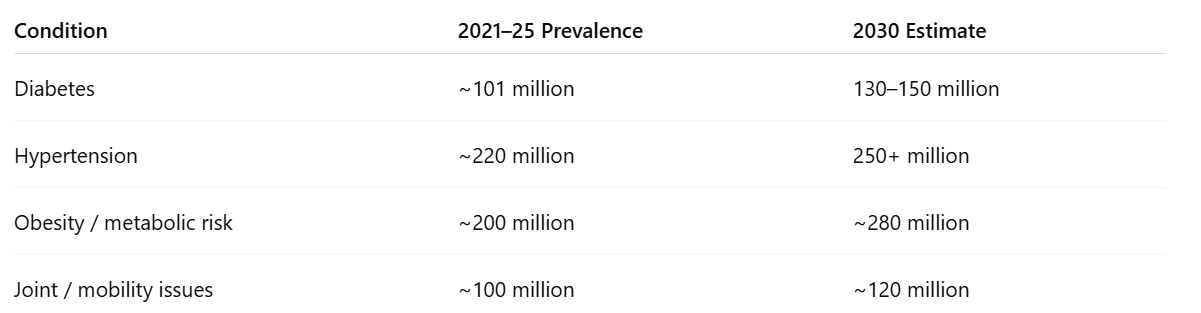
Heart disease, diabetes, hypertension, and obesity now account for more than two-thirds of India’s deaths.
Between 1990 and 2016, cardiovascular disease (CVD) cases more than doubled, and CVD-related deaths rose from 2.1 million in 2015 to 2.9 million in 2021, a 5.3 % CAGR.
If this trajectory holds, India will cross 4.5 million CVD deaths annually by 2030.
🌿 Ayurveda’s Second Act
Ayurveda is no longer a fringe wellness label.
It’s being recast as a credible partner in chronic-disease management, powered by policy, consumer, and global tailwinds.
1️⃣ Government & Policy Support
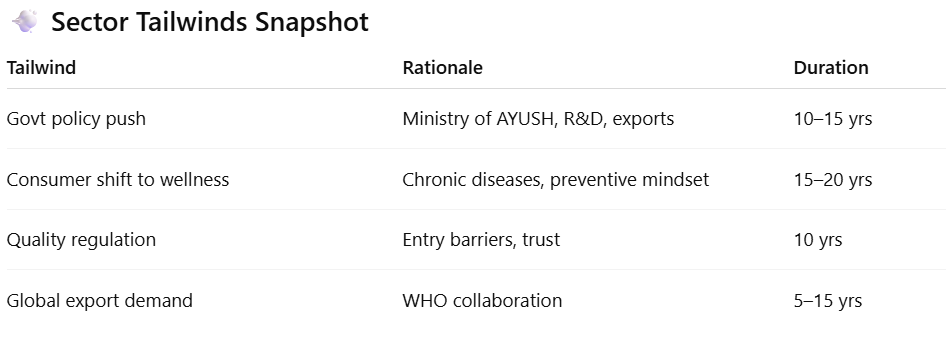
- Ministry of AYUSH investment push: market size from US$18 bn (2021) → US$43 bn (2024) → US$200 bn by 2030
- Schemes & incentives: export promotion, R&D funding, start-up recognition
- AI digitisation & regulation: quality standards and pharmacopoeia digitisation improve transparency
🕒 Tailwind duration: 10–15 years — structural, not cyclical.
2️⃣ Cultural Acceptance
Nearly 45 % of urban and 40 % of rural Indians used an AYUSH-based remedy in 2022–23.
Consumers now prefer natural yet data-backed healing — the exact positioning Ayurveda 2.0 occupies.
3️⃣ Global Ambition
India has signed WHO and bilateral AYUSH partnerships, positioning itself as a global traditional-medicine hub.
Export momentum expected to last another decade or more.
🏥 The Company: Madhavbaug (Vaidya Sane Ayurved Laboratories Ltd)
Madhavbaug focuses on reversal therapies for cardiac, diabetic, and metabolic disorders, operating:
- 333 clinics (owned + franchise)
- 4 hospitals (Khopoli, Nagpur, Vadodara, Visakhapatnam)
- 2 manufacturing units (Ayurvedic medicines & nutraceuticals)
Its revenue model is a mix of services and products, while its “MIB Pulse” app extends patient engagement digitally.
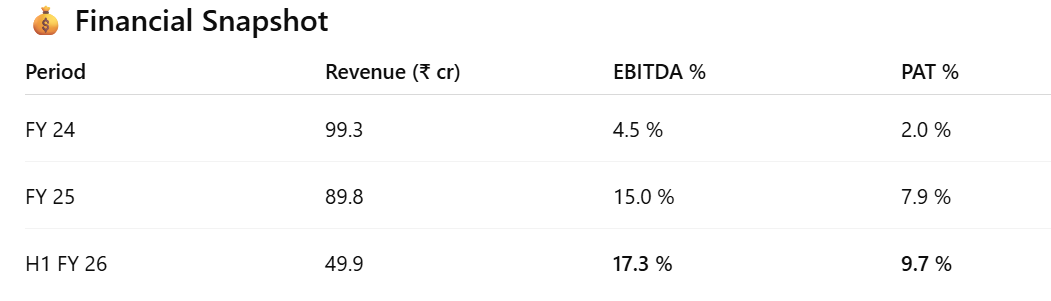
Margins have expanded sharply even amid flat revenue — signalling cost discipline.
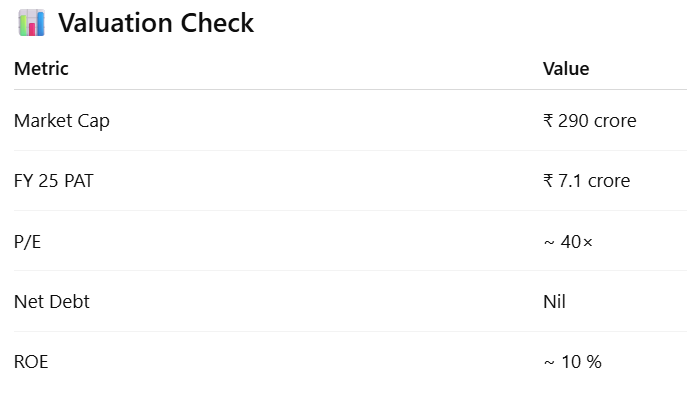
Madhavbaug remains debt-free, funding growth internally.
🌏 Market Opportunity
India’s chronic-disease population (≈ 300 mn) × average spend (₹ 20 k/year) =
a ₹ 2 trillion (~US$ 240 bn) total addressable market by 2030.
At a ₹ 290 cr market cap, the company currently captures 0.014 % of this universe.
Even a 0.1 % capture (₹ 2,000 cr revenue) could justify a ₹ 5,000 cr valuation.
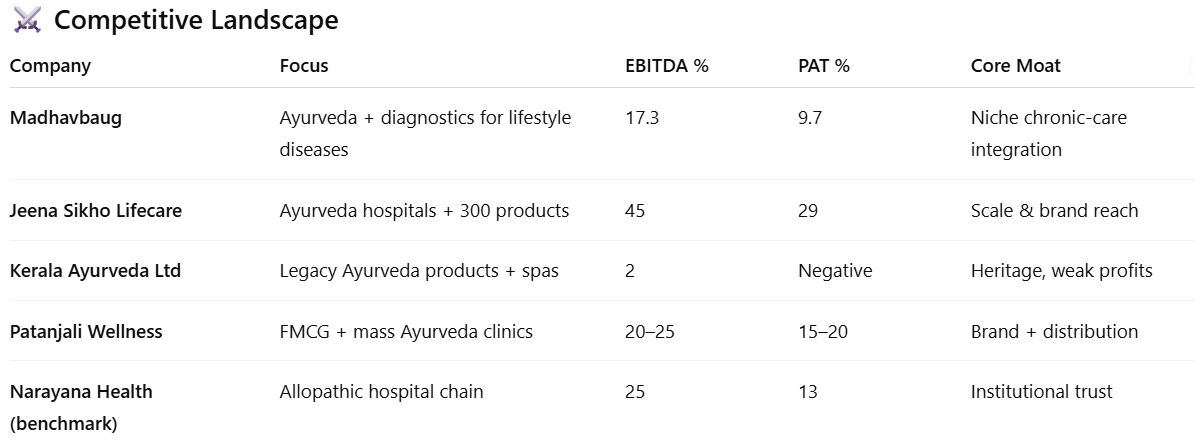
Madhavbaug stands between FMCG Ayurveda and allopathic hospitals, owning a “therapeutic Ayurveda” niche but lacking brand scale.
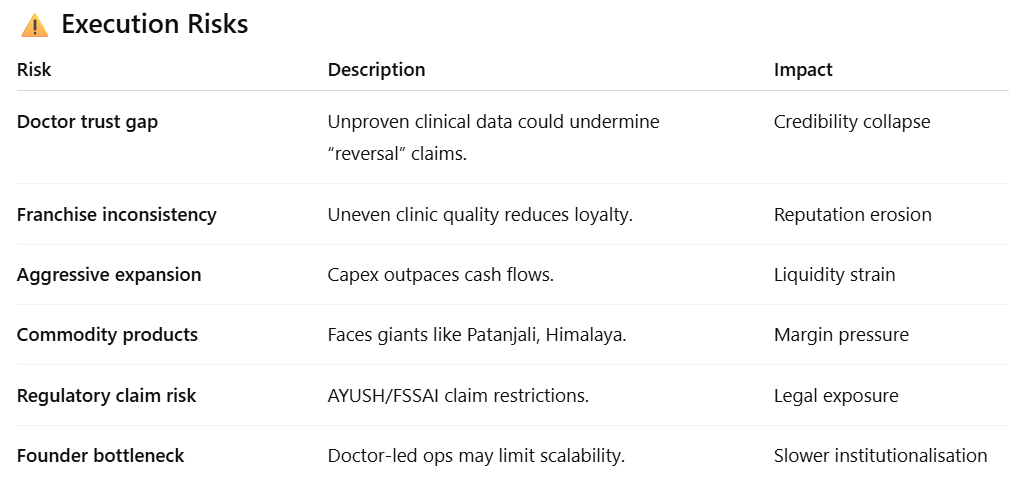
Rerating potential exists, but only if growth resumes and outcomes gain validation.
🔮 Analyst’s View
Demand: Structural and rising.
Balance Sheet: Strong and conservative.
Execution Risk: Medium-high.
Valuation: Moderate optionality; long runway.
Madhavbaug isn’t fighting to prove Ayurveda’s relevance — that war is already won. Its next battle is credibility, consistency, and scale.
If it can professionalize its network, maintain > 15 % margins, and publish credible outcome data, it could evolve from a ₹ 290 cr niche to a ₹ 5,000 cr compounder by the next decade.
🧠 Key Takeaway
India’s chronic-disease epidemic has created a trillion-rupee opportunity.
Ayurveda 2.0 — scientific, structured, and data-driven — will define the next decade.
Madhavbaug is one of its earliest organised bets.
More from Dalal Street Lens
 The ₹242 Bag That Broke India’s Farm Belt
 Pakistan’s Peace Dividend — and India’s Invisible Loss
 Most Investors Misread Accent Microcell. This Is the Real Business.
 Costco Business Model Explained: Why Costco Feels Different the Moment You Walk In
 McDonald’s Business Model Explained: Why It’s Not Really About Burgers
 Jesse Livermore Lessons
 Karnataka Bank Earnings Call Analysis – November 2025
 How Nassim Taleb’s Trading Philosophy Changed the Way I Look at Confidence in Markets
 Retail Investors vs Institutional Investors