
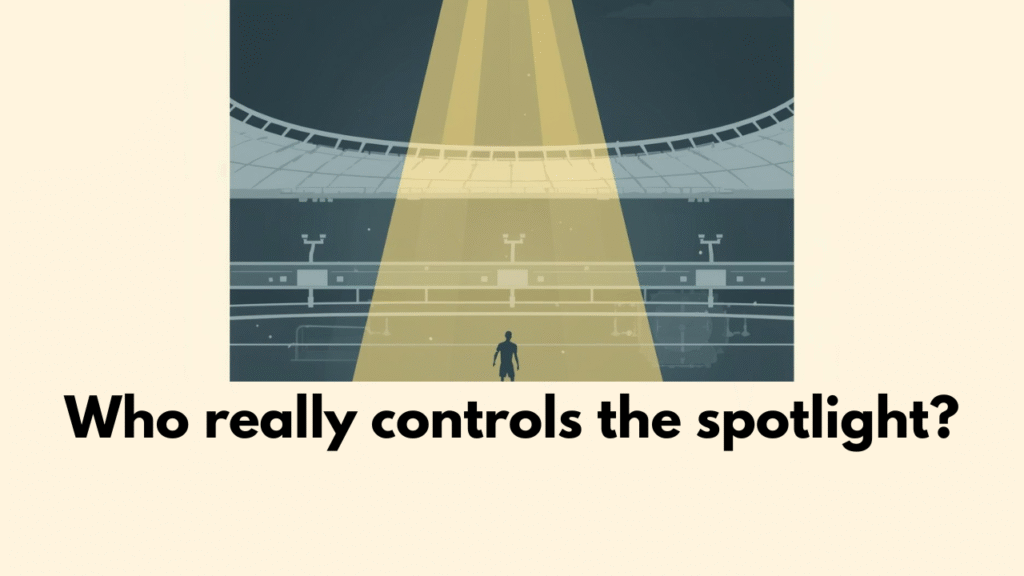
When Lionel Messi landed in India, it didn’t feel like a sporting event.
It felt like a moment.
Crowds. Cameras. Chaos. Headlines.
A few hours of presence, and weeks of noise.
To most people, this looked like football royalty blessing Indian soil.
To anyone watching closely, it looked like something else entirely.
This wasn’t football.
This was an attention trade.
And once you see it that way, the entire economics of celebrity events, and why Dalal Street keeps its distance, suddenly becomes clear.
Messi Isn’t the Business. Attention Is.
Here’s the uncomfortable truth most coverage misses:
Messi is not the product.
Attention is the product.
Messi is merely the source of attention — a powerful, scarce one, but the business revolves around how that attention is packaged, distributed, monetised, and risk-managed.
This single distinction explains:
- why organisers panic,
- why stars get paid first,
- and why public markets largely avoid this space.
Before going further, we need one simple mental model.
The Attention Value Chain
This is where the real story lies.
Step 1: Attention Creation
Who: Messi
Nature: Scarce, personal, globally recognisable
Risk: Zero
Step 2: Attention Control & Packaging
Who: Agents and management
What they sell: Appearance rights, image rights, time-bound access
Revenue type: Fixed
This is where the first cheque is written.
Step 3: Attention Distribution
Who: Event organisers, stadiums, platforms
Role: Bringing attention physically and digitally to consumers
Risk: Extremely high
Distribution is expensive, complex, and fragile.
Step 4: Attention Monetisation
Who: Organisers and partners
Revenue sources:
- Ticket sales
- Premium experiences
- Sponsorships
- Media clips
- Merchandise
Revenue here is variable, not guaranteed.
Step 5: Risk Absorption
If logistics fail, crowds turn hostile, or expectations are mismanaged, the organiser absorbs the damage —> financially and reputationally.
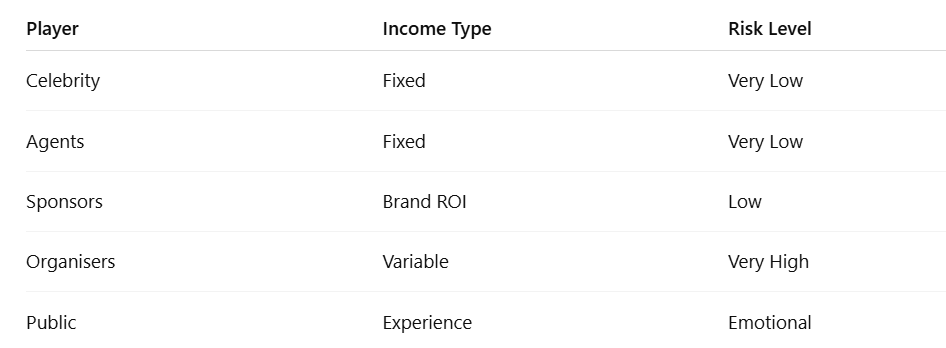
This is why chaos hurts promoters, not stars.
Who Gets Paid First, and Who Prays Last
In attention trades, payment order matters more than upside.
Fixed-Income Players
- Celebrities
- Agents
- Certain vendors
They are paid before the first ticket is scanned.
Variable-Income Players
- Event promoters
- Ticket-linked partners
They earn only if everything goes right.
Optionality Players
- Sponsors
- Media platforms
- Social networks
They gain visibility without execution risk.
Insight:
In volatile businesses, certainty beats upside.
Why This Is a Terrible Public Market Business
The obvious question now is:
If so much money is involved, why isn’t Dalal Street all over this?
Because structurally, this business fails public-market tests.
No Operating Leverage
Each event resets to zero.
No Repeatability
Attention decays the moment the event ends.
No Moat
Relationships are not defensible assets.
Asymmetric Risk
One bad night can wipe out years of goodwill.
This is why most large promoters stay private, and why listed markets prefer boring, scalable pipes over glamorous stages.
Then Where Does Dalal Street Actually Make Money?
Not at the event.
Around it.
Attention Pipes
- Media companies
- Streaming platforms
- Distribution networks
They monetise attention regardless of who creates it.
Attention IP
- Sports leagues
- Music catalogues
- Franchises
They don’t rent attention — they own it.
Platforms Over Performers
Platforms scale. Performers peak.
That’s why IPL franchises compound value, while one-off tours don’t.
India’s Live Events Future: What Will Change, What Won’t
What Will Grow
- Frequency of global tours
- Willingness to pay for experiences
- Brand-led events
What Will Remain Risky
- Crowd management
- Regulation
- Execution dependency
- Reputation sensitivity
What Would Need to Change for a Listed Giant to Emerge
- Long-term IP ownership
- Insurance depth
- Multi-year contracts
- Platform-level scale
Until then, this remains a high-glamour, high-risk private market game.
How to Read Event Headlines Like an Investor
Next time you see a flashy event headline, ask three questions:
- Who owns the attention?
- Who is renting it temporarily?
- Who gets paid even if things go wrong?
The answers will tell you everything you need to know.
FAQs
Is the celebrity event business profitable?
Sometimes, but profits are volatile and non-compounding.
Why are stars paid regardless of success?
Because they own the attention source.
Why aren’t there listed event promoters in India?
Because public markets dislike execution-heavy, reputation-sensitive models.
Can investors benefit from the live events boom?
Yes — indirectly, through media, platforms, and IP owners.
Final Thought: Owning the Switch, Not the Spotlight
In the attention economy, the loudest moment is rarely the most valuable one.
The real money isn’t made under the spotlight.
It’s made by those who own the switch that turns it on.
Once you see that, you’ll never read a celebrity headline the same way again.
Harsh is the creator of Dalal Street Lens, where he writes about investing, market behaviour, and financial psychology in a clear and easy way. He shares insights based on personal experiences, observations, and years of learning how real investors think and make decisions.
Harsh focuses on simplifying complex financial ideas so readers can build better judgment without hype or predictions.
You can reach him at imharshbhojwani@gmail.com
More from Dalal Street Lens
 Most Investors Misread Accent Microcell. This Is the Real Business.
 Costco Business Model Explained: Why Costco Feels Different the Moment You Walk In
 McDonald’s Business Model Explained: Why It’s Not Really About Burgers
 Jesse Livermore Lessons
 Karnataka Bank Earnings Call Analysis – November 2025
 How Nassim Taleb’s Trading Philosophy Changed the Way I Look at Confidence in Markets
 Retail Investors vs Institutional Investors
 Second Order Thinking in Investing: Four Decisions I Had to Learn the Hard Way
 Cost Structure Is Destiny
 India’s Data Centre Supercycle: The Simplest Explanation of Colo, Cloud and AI Infrastructure