
1. Introduction
Whether the market is flying, falling, or standing around pretending to be busy, one thing never changes:
Everyone wants to know what FIIs and DIIs did today.
In a bull market, these numbers feel like rocket fuel:
“FII bought ₹3,000 crore? Bro, rally confirmed!”
In a bear market, the same numbers feel like blood pressure updates:
“FII sold again? Bas, ab toh gaya!”
And even in sideways markets, people stare at the flow data like students checking exam results a day early, hoping for clues that may or may not exist.
But here’s the twist:
These numbers look simple.
The behaviour behind them is not.
FIIs don’t cry when you cry.
DIIs don’t cheer when you cheer.
LIC doesn’t open a cape and fly in daily.
And retail investors often decode these flows with full confidence and zero context.
The truth?
FIIs, DIIs, and LIC operate on completely different rulebooks, powered by:
- global liquidity
- domestic flows
- valuations
- risk cycles
- mandates
- and occasionally… pure survival instinct
This blog breaks down the entire machinery with humour, honesty, and clarity, so you walk away understanding:
- Why FIIs run when the Fed sneezes
- Why DIIs sometimes buy fear and sometimes avoid madness
- Why LIC shows up only when the chaos discount hits 30%
- Why real crashes only happen when both big players step back
- And how you should interpret FII–DII flows without losing your mind in any market phase
Let’s decode India’s favourite tug-of-war finally, without the drama.
2. FIIs & DIIs: Not Gods, Not Villains — Just Big Wallets
2.1 FIIs: The Moody NRI Rishtedaar
FIIs are like that NRI cousin who randomly lands in India with dollars and nostalgia…
and runs back the moment the power goes out.
People think FIIs react to Indian events.
GDP 7%, earnings strong, India shining…
They don’t care.
FIIs react to America reacting to America reacting to its own problems.
They have only two real Gods in their life:
1. US Federal Reserve
2. US 10-Year Bond Yields
If the Fed sneezes, FIIs get fever.
If the Fed coughs, FIIs pack their bags.
If bond yields go up even by 0.10%, FIIs run faster than Indians run when the first rain hits after summer.
Why?
Because US bond yields are like:
- Free returns
- No tension
- No volatility
- No “Adani”, “China”, “Oil”, “Election”, “RBI”, “Rupee” kind of drama
When the US gives them 4–5% guaranteed, why stay in a place where markets behave like an auto-rickshaw on a pothole?
That’s why the Indian market can be partying…
but FIIs will still say:
“Bro, Dollar bulata hai… hum jaata hain.”
2.2 DIIs: The Sanskaari Cousin Who Actually Does His Homework
DIIs are the grown-ups in the room:
- Mutual funds
- Insurance companies
- EPFO
- Pension funds
They don’t react to news cycles.
They don’t panic with every FII sneeze.
They follow these boring things:
- Valuation
- Long-term mandate
- SIP inflows
- Asset allocation
- Risk rules
Basically, DIIs are the CA cousins while FIIs are the DJ cousins.
3. How FIIs & DIIs Influence Markets (and Pull Each Other’s Hair)
3.1 FIIs: The Short-Term Movers
When FIIs buy, markets behave like they drank Red Bull.
When they sell, markets behave like the Indian batting lineup in early 2000s.
But FIIs move for global reasons:
- US Bond yields
- Dollar Index
- Global risk-off
- Fed meetings
- Geopolitical shocks
India is just the side-effect.
3.2 DIIs: The Long-Term Stabilizers
DIIs don’t chase rallies.
They don’t dump stocks when India cracks 2%.
They prefer:
- Stability
- Discipline
- Buying the dip
- Slow rebalancing
- Long-term compounding
DIIs are basically the financial version of Amul:
reliable, consistent, everyday hero.
3.3 Why It Looks Like They Fight Each Other
FIIs sell → DIIs buy
FIIs buy → DIIs book profits
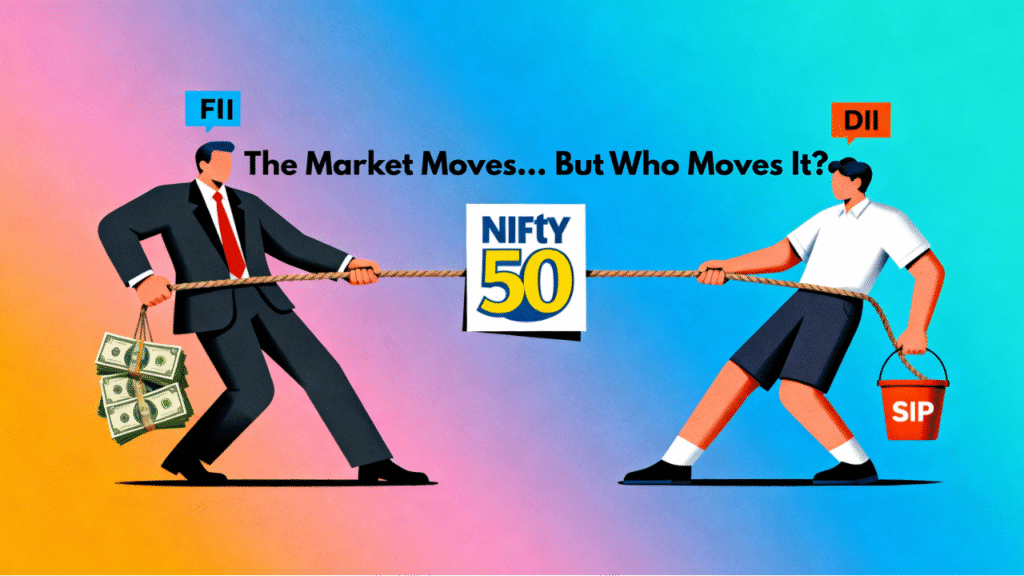
Repeat cycle → Twitter calls it “Tug of war”
In reality:
It’s not war.
It’s just liquidity changing hands.
4. The Biggest Myth: “DIIs Buy When FIIs Sell”
4.1 Why People Believe This
Because SIP inflows make DIIs look like superheroes.
Every month crores land in mutual funds like EMI payments from a very disciplined India.
So when FIIs sell, DIIs naturally absorb some of it.
People think:
“DIIs are saving the market.”
Cute thought.
But wrong.
4.2 When This Myth Dies
DIIs do NOT buy when:
- Markets are overheated
- Valuations touch Jupiter
- Global panic is intense
- They’re raising cash for safety
And when DIIs step back AND FIIs are selling…
That’s when market goes from:
Nifty50 → NiftyPanic50
5. Rebalancing: The Secret Nobody Talks About
5.1 What Is Rebalancing?
Imagine a thali where paneer overflows but dal is missing.
Rebalancing means:
- Fix the thali
- Stop overeating paneer
- Bring proportions back
5.2 Why DIIs Rebalance
- To maintain the right risk
- To follow mandate
- To avoid overexposure
5.3 Why FIIs Rebalance
- To cut global risk
- To rotate money
- To reduce volatility
5.4 How Rebalancing Creates FII–DII Illusions
FIIs sell because they’re scared.
DIIs buy because valuations became sweet.
Looks like rivalry.
Actually just:
“One is panicking, one is bargain hunting.”
6. LIC: The Market’s Silent Bouncer
6.1 Does Government Order LIC to Support Markets?
No.
That would be illegal.
6.2 But Does LIC Support Markets During Crises?
Yes.
Out of habit.
Out of balance sheet strength.
Out of “we’ve seen 50 years of this nonsense.”
LIC during Covid crash:
“Acha sale mila. Packing karo.”
6.3 Why LIC Behaves Differently
LIC is not your typical mutual fund.
Its liabilities are 20–30 years long.
It loves lower prices.
It loves panic.
It loves crashes.
LIC is that uncle who calmly eats jalebi while everyone else is screaming “Earthquake!”
7. The Nightmare Nobody Discusses: When FIIs Sell AND DIIs Step Back
7.1 This Is When Markets Actually Crash
FIIs panic.
DIIs say, “Yeh mehenga hai.”
LIC says, “Abhi nahi.”
Retail says, “Stop-loss hit.”
Brokers say, “Margin call.”
Markets say, “Dhappa.”
7.2 Historical Examples
- 2008
- 2011
- Early 2020 (pre-LIC intervention)
These periods were not “corrections.”
They were “gravity doing its MBA.”
7.3 What Happens When Both Step Back
- Liquidity disappears
- No bid in the market
- Prices gap down
- Smallcaps behave like their brakes failed
- Retail discovers spirituality
8. What Happens to SIP Money If DIIs Don’t Want to Buy
8.1 They Don’t Deploy Immediately
DIIs are not pizza delivery.
No rule says: “Buy within 30 minutes.”
8.2 They Increase Cash
This is the financial equivalent of:
“Let the storm pass. Hum baad mein aayenge.”
8.3 They Park It Safely
- Liquid funds
- Overnight funds
- Short-term bonds
Think of it as “waiting in the lobby.”
8.4 They Buy Selectively
When valuations look drunk, DIIs buy only:
- High-quality names
- Defensive pockets
- Underpriced sectors
9. Should Retail Track Daily FII–DII Data?
9.1 Daily Data = Masala, Not a Meal
Fun for Twitter.
Totally useless for strategy.
9.2 What Daily Data CAN Tell You
- Market mood
- Foreign panic level
- Domestic confidence
9.3 What Daily Data CANNOT Tell You
- Tomorrow’s direction
- Next crash
- Your portfolio’s future
- Why your smallcap behaves like a Bollywood villain
9.4 Retail Playbook (Simple & Savage)
- Daily flows → Gossip
- Weekly flows → Trend
- Monthly flows → Insight
- Quarterly flows → Institutional confidence
10. 10 Most Googled Questions About FIIs & DIIs
1. Who are FIIs & DIIs?
Foreign moody cousins vs domestic disciplined cousins.
2. Why do FIIs move the market so fast?
Because their money volume = tsunami.
3. Why do DIIs buy when FIIs sell?
Because SIPs are raining money.
4. Do FIIs control the market?
Short-term, yes.
Long-term, no.
LIC laughs.
5. Should retail copy FII trades?
Only if you enjoy pain.
6. Why do FIIs panic during global scares?
Because they live and die by US bond yields.
7. Are DIIs safer?
DIIs are predictable.
FIIs are like monsoons.
8. Can DIIs trigger a crash?
Yes — if they stop buying during overvaluation.
9. Where can you check daily data?
NSE website.
But don’t become addicted.
10. Should retail care about daily flows?
Only the trends. Not the drama.
11. Key Takeaways
- FIIs react to America, not India.
- DIIs are disciplined, not emotional.
- LIC saves markets because it can.
- Crashes happen when BOTH FII + DII step back.
- Retail should watch trends, not daily mood swings.
- Market = liquidity dance, not hero-villain drama.
12. Conclusion: The Market Is a Dance, Not a War
FIIs lead some days.
DIIs lead other days.
LIC joins when everyone else faints.
This is not a battle between foreigners and Indians.
This is just money rotating between fear, greed, valuation, and opportunity.
Understand the rhythm.
Ignore the noise.
And for God’s sake stop checking FII–DII data like it’s your girlfriend’s last-seen.
If you liked this blog, you might enjoy my previous ones as well:
👉 Why Cheap Stocks Trap You — The Psychology Behind It
👉Why Nifty Is at All Time Highs but Your Portfolio Is in the Basement
👉AI Won’t Crash Like 2000. It Might Correct Like 2008 — When Reality Finally Shows Up.
👉Strong USD Is Not a Modi Issue or a Congress Issue — It’s Global
👉 Why We Feel Smarter After a Stock Falls: The Psychology of Market Regret
👉 Why Comparing Your Portfolio to Others Destroys Your Returns
👉Is Your Stock a Hidden Pump-and-Dump?
Harsh is the creator of Dalal Street Lens, where he writes about investing, market behaviour, and financial psychology in a clear and easy way. He shares insights based on personal experiences, observations, and years of learning how real investors think and make decisions.
Harsh focuses on simplifying complex financial ideas so readers can build better judgment without hype or predictions.
You can reach him at imharshbhojwani@gmail.com
More from Dalal Street Lens
 Most Investors Misread Accent Microcell. This Is the Real Business.
 Costco Business Model Explained: Why Costco Feels Different the Moment You Walk In
 McDonald’s Business Model Explained: Why It’s Not Really About Burgers
 Jesse Livermore Lessons
 Karnataka Bank Earnings Call Analysis – November 2025
 How Nassim Taleb’s Trading Philosophy Changed the Way I Look at Confidence in Markets
 Retail Investors vs Institutional Investors
 Second Order Thinking in Investing: Four Decisions I Had to Learn the Hard Way
 Cost Structure Is Destiny
 The Attention Economy Trade: Who Really Makes Money When Global Stars Visit India
Superb…. Really Enjoyed this this one!
Always superb
Thanks for the awareness post.