
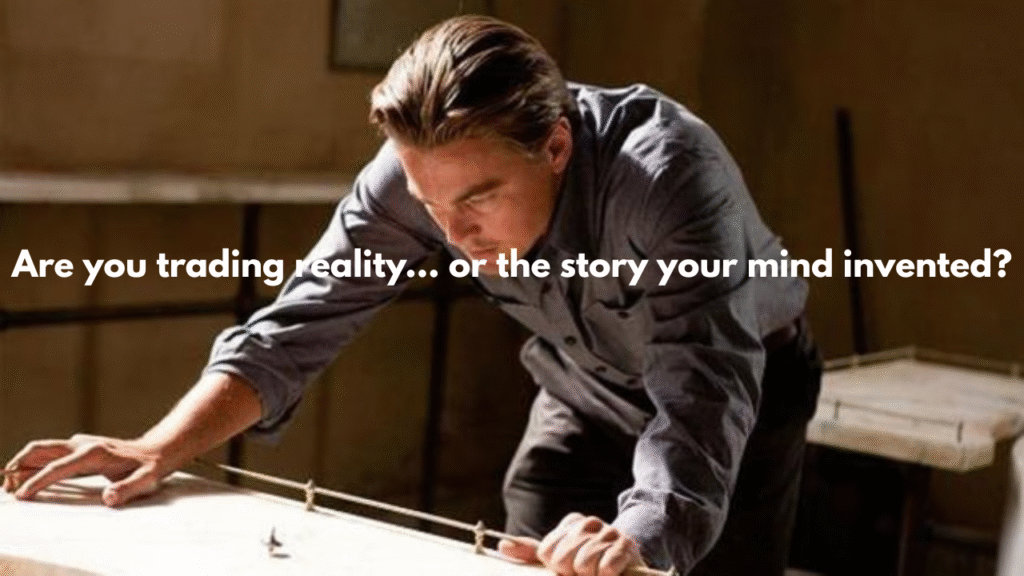
Every investor is scared of drawdowns.
Every investor is terrified of bear markets.
And every investor, secretly, thinks they’re immune to stupidity because they’ve read at least one finance book and follow five experts on X (formerly known as a platform where people pretended to be rational).
But the truth — an inconvenient one — is this:
The biggest risk in investing is not the market.
It’s the story your own brain whispers to you.
We all like to believe we operate in a world of charts, ratios, screener data, discounting cash flows like a monk chants mantras.
But the real world of investing is not built on numbers.
It is built on narratives.
These narratives are created by markets, or managements, or mutual funds.
And most important part is created inside your own skull.
Welcome to the real battlefield: your mind’s storytelling engine.
1. THE BRAIN: EVOLUTION’S MOST TALENTED FICTION WRITER
We humans think we are rational.
Markets know better.
Your brain was not designed in a Bloomberg lab.
It was designed on a savannah where the biggest risk was a tiger, not a twenty-bagger temptation.
Back then, you didn’t need accuracy.
You needed speed.
You needed certainty.
You needed a story, any story —> that kept you alive.
And that’s why the brain still behaves like this today:
- Reality arrives as chaos
- The brain panics
- It ties three random dots together
- And presents you a beautifully coherent explanation…
that has the logical strength of a WhatsApp forward
It doesn’t matter if the dots were related.
It only matters that the story made you feel safe for five seconds.
That’s why markets move.
Not because of GDP data
because of the stories people invent to avoid feeling uncertain.
2. WHY YOU AND BILLIONS OF OTHERS CONNECT DOTS THE SAME WAY
If you ever wondered why the entire market becomes bullish on the same sector at the same time, relax.
It’s not because everyone suddenly discovered hidden wisdom.
It’s because everybody’s brain comes pre-installed with:
- Confirmation Bias 7.0
- Narrative Fallacy Premium Edition
- Overconfidence Plus (Lifetime Subscription)
We’re all running the same prehistoric operating system.
Show humans some numbers — they’ll build you a forecast.
Show them a forecast — they’ll build you a fantasy.
Show them a fantasy — they’ll build you a portfolio.
Humans may disagree on politics, cricket teams, and pani puri spice levels.
But on one thing, they’re carbon copies:
Everyone wants a story that makes sense, not a reality that is true.
3. THE SECRET BUGS IN THE HUMAN OPERATING SYSTEM
Now let’s talk about the hidden glitches that trip even the smartest —> the behavioural equivalent of software crashes.
3.1 The Coherence Addiction
Humans can watch 7 straight hours of Netflix but cannot bear 5 seconds of uncertainty.
So the brain cooks up a neat explanation for absolutely anything, even if the explanation is nonsense.
Markets don’t need to make sense.
Your brain does.
3.2 Bias on Auto-Pilot
You are not choosing your opinions.
Your opinions are choosing you.
Decisions are made emotionally in the basement of your mind.
Your intellect arrives later and drafts a press release explaining why it was a brilliant idea.
3.3 Noise: You Are a Different Analyst Every Day
Same data.
Different mood.
Different decision.
You don’t realise this because your brain wraps inconsistency in elegant justification.
3.4 The Great Confidence Scam
Humans are capable of being confidently wrong for decades.
Ask people who bought peak PSU stocks in 2008.
Or people who said “Tesla is finished” every year since 2013.
Confidence sells.
Accuracy whispers.
3.5 Storytelling Without Consent
You’re not the writer.
You’re the audience.
The narrative forms automatically.
Your brain simply informs you of your new beliefs like a software update.
3.6 Hindsight Editing
After an outcome, the brain quietly rewrites memory to make it look inevitable.
You didn’t “see the crash coming.”
Your brain is lying to protect you.
3.7 The Amplifiers: Media, Markets, and Friends
Modern markets don’t spread information.
They spread emotions.
Narratives go global before reality even wakes up.
And yet we ask why people make stupid trades.
4. REALITY VS. PERCEIVED REALITY: TWO DIFFERENT UNIVERSES
There are two worlds:
A. Objective Reality
Cold, hard, indifferent truth.
Cash flows, competition, execution, economics.
B. Perceived Reality
The colourful, emotionally decorated story running inside your mind.
Investors rarely operate in A.
They live in B.
Two investors look at the same P&L.
One sees opportunity.
One sees danger.
One sees a multibagger.
One sees a meltdown.
The company hasn’t changed.
Only the story has.
Wisdom is not knowing the truth.
Wisdom is knowing how much of what you believe is a story.
5. THE P&L STATEMENT: THE MOST RESPECTABLE STORY IN FINANCE
Let’s be honest.
When you open Screener and admire a company’s numbers, you are not looking at reality.
You are looking at:
- accrual accounting
- assumptions
- interpretations
- management judgment
- auditor acceptance
- and finally… your own imagination layered on top
Numbers are not truth.
They’re stories told according to accounting rules.
Retail investors don’t have forensic teams.
Even institutions get fooled.
And yet…
You don’t need absolute truth to make money.
You just need to avoid the obviously fake stories.
Cash flows don’t lie often.
Management does.
6. THE INCEPTION TOTEM FOR INVESTORS:
A 3-SECOND TEST TO KNOW IF YOU’RE IN A STORY
Here’s your instant reality detector — like the spinning top in Inception.
TOTEM 1: Evidence vs Emotion Test
Ask:
“If I remove my feelings, what remains?”
If nothing remains → you’re in a story.
TOTEM 2: The “If I Didn’t Own It…” Test
Ask:
“Would I still believe this if I had zero position?”
If no → story.
TOTEM 3: Disconfirming Evidence Test
Ask:
“What would prove me wrong?”
If you can’t answer → you’re dreaming.
These three questions have saved more portfolios than any ratio ever invented.
7. TAM: THE GRANDEST STORY THE MARKET LOVES
Every great investor makes one dangerous bet:
“The company’s market is big today…
but trust me, it will be much bigger tomorrow.”
This is storytelling at its finest.
And completely unavoidable.
But here’s how pros separate fantasy TAM from credible TAM.
✔ A TAM story is strong when it:
- aligns with existing behaviour
- doesn’t require miracles
- has multiple paths to success
- is consistent with the company’s past
- is anchored in present cash flows
- survives “What breaks this story?” analysis
✘ A TAM story is weak when it:
- requires people to behave like superheroes
- collapses if one assumption fails
- contradicts industry history
- depends on perfection
- is held together by hope rather than cash flow
- cannot answer “What will prove me wrong?”
Great investors don’t look for perfect predictions.
They look for robust stories, stories that work even when life misbehaves.
8. WHERE THE REAL EDGE LIES
People think investors beat the market by predicting the future.
Wrong.
Investors beat the market by escaping their own stories sooner than others.
That’s the entire game.
The ones who understand:
- What is reality
- What is perception
- What is interpretation
- What is emotional narrative
- And what is sheer fantasy
…are the ones who compound wealth decade after decade.
You don’t need a genius brain.
You need a brain that can say:
“This is my story.
But it might be wrong.
Let me check.”
That humility is the ultimate edge.
THE FINAL WORD
Reality exists.
But your mind rarely shows it to you directly.
It shows you a version you can emotionally survive.
The investor who learns to subtract these stories, even a little, steps closer to truth.
And in markets, truth compounds faster than fantasy.
Because the market rewards clarity…
and punishes storytelling.
Unless you write the story yourself.
If you liked this blog, you might enjoy my previous ones as well:
👉 Why Cheap Stocks Trap You — The Psychology Behind It
👉Why Nifty Is at All Time Highs but Your Portfolio Is in the Basement
👉AI Won’t Crash Like 2000. It Might Correct Like 2008 — When Reality Finally Shows Up.
👉Strong USD Is Not a Modi Issue or a Congress Issue — It’s Global
👉 Why We Feel Smarter After a Stock Falls: The Psychology of Market Regret
👉 Why Comparing Your Portfolio to Others Destroys Your Returns
👉Is Your Stock a Hidden Pump-and-Dump?
Harsh is the creator of Dalal Street Lens, where he writes about investing, market behaviour, and financial psychology in a clear and easy way. He shares insights based on personal experiences, observations, and years of learning how real investors think and make decisions.
Harsh focuses on simplifying complex financial ideas so readers can build better judgment without hype or predictions.
You can reach him at imharshbhojwani@gmail.com
More from Dalal Street Lens
 Most Investors Misread Accent Microcell. This Is the Real Business.
 Costco Business Model Explained: Why Costco Feels Different the Moment You Walk In
 McDonald’s Business Model Explained: Why It’s Not Really About Burgers
 Jesse Livermore Lessons
 Karnataka Bank Earnings Call Analysis – November 2025
 How Nassim Taleb’s Trading Philosophy Changed the Way I Look at Confidence in Markets
 Retail Investors vs Institutional Investors
 Second Order Thinking in Investing: Four Decisions I Had to Learn the Hard Way
 Cost Structure Is Destiny
 The Attention Economy Trade: Who Really Makes Money When Global Stars Visit India