
How Operators, Promoters, and Psychology Fool Even the Smart Ones
There are two types of stocks in the world:
Those that grow because the business improves…
and those that grow because someone decided today is a good day to dump on the gullible.
You already know which category creates the most drama.
Every few weeks, the same Bollywood remake plays out in the markets:
Some obscure microcap wakes up, stretches, has chai, and suddenly shoots up 14%, 19%, and then hits upper circuit as if it just inhaled industrial-strength optimism.
Twitter calls it “momentum.”
YouTube calls it “next multibagger.”
Operators call it… Tuesday.
A few days later, the volume dies, the price cracks, and the same retailers who entered with the enthusiasm of an IPO queue start looking at the chart like it’s their engineering result: “Yeh kya ho gaya?”
Let’s be honest — most people didn’t “discover” the stock.
They got caught in a psychological booby-trap designed by professionals who understand human emotions better than therapists do.
This blog is about that trap.
And how even seasoned investors walk into it wearing noise-cancelling headphones.
The Uncomfortable Truth:
Pump-and-dumps don’t succeed because operators are smart.
They succeed because investors are predictable.
If you put a thousand humans in a market long enough, their behavior becomes a spreadsheet.
And operators are very good with spreadsheets.
Their entire model is:
- Create excitement.
- Manufacture legitimacy.
- Trigger emotions.
- Offload positions.
- Vanish into the market like a politician after elections.
Retailers, professionals, institutions — everyone thinks they’re too intelligent to fall for it.
But intelligence is useless in front of an emotion that feels correct.
Let’s go through the psychology that turns the most educated investors into highly efficient exit liquidity.
1. FOMO: The World’s Most Reliable Trading Indicator
If you ever want to test how emotionally stable the market is, show it a green candle.
Markets react to green candles the way Indians react to weddings:
Uninvited, overly excited, and 100% convinced that something big is happening.
The moment a stock jumps 10–15% in a day with no real news, most investors don’t ask,
“Why is this happening?”
They ask,
“Why am I not in this?”
This is not an emotion.
This is a pre-existing medical condition.
Operators know the exact dosage needed.
Two vertical moves and one upper circuit later, the chart is no longer a warning sign — it becomes a personality test for greed.
And greed, historically, has never failed to outperform logic
2. Social Proof: If Everyone is Buying, Surely They All Can’t Be Wrong?
They can be.
And often are.
One of the easiest psychological tricks operators use is fake volume patterns that mimic institutional accumulation.
Large identical trades.
Unusually round lots.
Delivery spikes that look “smart.”
It’s like watching a crowd gather around an empty street and thinking there must be something worth seeing.
Humans derive confidence from others’ confidence.
Even professionals fall for this.
Because nothing seduces the market more than the illusion of “some big hand is buying.”
But the big hand is usually the left hand of the operator and the right hand of his cousin.
Nothing institutional here except the accuracy with which retail gets trapped.
3. Anchoring: “It was 200 once, so 200 again is easy.”
Anchoring is one of the most expensive hallucinations in the market.
Promoters know this.
Operators know this.
Your brokerage app definitely knows this.
Every pump uses a familiar anchor:
- “Last bull run it hit 300.”
- “This stock used to be 2000 before 2008.”
- “It’s still cheaper than peers.”
Retail doesn’t run DCF (Discounted Cash Flow) models.
They run nostalgia.
Anchoring works because humans treat price as memory instead of math.
This is why operators never need to say anything.
Just zoom out the chart and let your imagination do the rest.
4. The Multibagger Fantasy: The Core Reason All Pumps Work
Let’s be direct:
Retail doesn’t want 12% returns.
They want 12% per hour.
Why?
Because the market sold them a dream:
“If this tiny stock becomes the next Infosys, you will retire before your boss realizes you quit.”
Promoters fuel this with:
- Glassy investor presentations,
- Futuristic claims,
- Capacity expansions that sound like a TED talk,
- MoUs that matter as much as New Year gym memberships.
Every pump has one thing in common:
A fantastic story with zero accountability.
Humans fall in love with stories.
Markets fall for numbers.
Promoters exploit humans.
5. The Most Dangerous Layer:
How Promoters Manufacture Legitimacy
This is where the real artistry lies.
Because a pump doesn’t work unless the stock looks respectable first.
Promoters know that you won’t trust a stranger.
So they dress the stranger up in a tuxedo and tell you he’s a CEO.
Let’s decode the legitimacy factory:
(a) Cosmetic Press Releases
These announcements are the business equivalent of telling your relatives you joined a startup that’s “still in stealth mode.”
No details.
No substance.
Just noise.
(b) Paid Media Mentions
Small portals, pseudo-analysis blogs, YouTube channels with suspiciously enthusiastic thumbnails — these are all part of the same marketing department.
A little PR goes a long way in fooling a lot of investors.
(c) Token Insider Buying
1000 shares bought by the promoter?
Relax.
That’s not confidence.
That’s theatre.
(d) Buzzword Bombing
Every pump stock suddenly becomes a leader in:
AI, EV, Drone Tech, Defence, Hydrogen, Railways, SaaS, and possibly spiritual wellbeing.
Suddenly, this ₹400-cr company is “disrupting multiple sectors.”
(e) Temporary Corporate Clean-Up
New CFO.
Website redesign.
LinkedIn posts.
Board meeting photos.
Promoters spend three months looking like McKinsey-trained visionaries, and three years hiding when the dump begins.
6. The Shocker:
Even Professionals Fall for This
This is the part retail investors don’t believe — but must understand.
Even seasoned professionals, PMS managers, analysts, and desk traders fall for sophisticated pumps.
Here’s why:
Theme Alignment
If defence is running, every small-cap duct-tape manufacturer becomes a “strategic defence supplier.”
Professionals chase themes.
Operators exploit themes.
Algo Signals
Fake breakouts trigger actual algos.
Smart money ends up buying dumb liquidity.
Sector Rerating
When one stock in a sector runs, analysts assume the laggards will follow.
Operators know this and time pumps accordingly.
“Improving Numbers” Illusion
Two quarters of slightly better revenue and one decent PAT figure?
Professionals smell a turnaround.
Operators smell fresh meat.
Institutional-Looking Trades
Operators imitate fund-style order sizes.
Professionals scanning data think:
“Who’s accumulating this?”
Answer:
Someone who plans to sell it to you.
7. The Psychological Playbook of a Pump (Phase by Phase)
If Marvel made a movie on stock operators, this would be the script:
Phase 1: Curiosity (Seduction)
Small move.
No noise.
Just enough to catch attention.
Phase 2: Excitement (Temptation)
Vertical candles.
Volume bursts.
The kind of chart that makes investors forget their risk appetite.
Phase 3: Conviction (Belief)
Promoter announcements.
Analyst chatter.
The illusion of institution buying.
Phase 4: Frenzy (Liquidity)
Retail enters.
Professionals enter.
Algos enter.
Everyone becomes lead actors in a movie they didn’t audition for.
Phase 5: Abandonment (Dump)
Operators exit silently.
Promoters go missing.
Retail is left holding a stock that falls with the commitment of a New Year diet plan.
8. The Warning Signs You’re Inside a Pump-and-Dump
Look for these:
- Sudden vertical rallies with no real news
- Artificial, jerky volumes
- Too many buzzword filled announcements
- Delivery percentage collapsing
- Upper circuits becoming a lifestyle
- No genuine institutional interest
- Promoters becoming unusually enthusiastic
If it looks like a pump, walks like a pump, and smells like a pump — congratulations, it is not a bakery.
9. How to Protect Yourself (Without Becoming a Cynic)
The goal is not paranoia.
The goal is survival.
- Verify business reality, not business drama.
- Focus on cash flows, not press releases.
- Track promoter behavior, not their vocabulary.
- Trust sector leaders, not sector tourists.
- Remember: real companies grow slowly.
- Avoid low-float microcaps unless you enjoy extreme sports.
- If something feels too smooth, too vertical, too perfect — step aside.
Markets reward patience.
Operators reward gullibility.
Choose your team.
Final Word
A real multibagger grows because the business improves.
A pump-and-dump grows because someone wants to exit.
And when the exit happens, the elevator doesn’t stop at your floor.
It goes straight down.
If this blog saves you from even one psychological trap, remember:
Survival in the markets is easier when you don’t let greed outsource your thinking.
If you liked this blog, you might enjoy my previous ones as well:
👉 Why Cheap Stocks Trap You — The Psychology Behind It
👉Why Nifty Is at All Time Highs but Your Portfolio Is in the Basement
👉AI Won’t Crash Like 2000. It Might Correct Like 2008 — When Reality Finally Shows Up.
👉Strong USD Is Not a Modi Issue or a Congress Issue — It’s Global
👉 Why We Feel Smarter After a Stock Falls: The Psychology of Market Regret
👉 Why Comparing Your Portfolio to Others Destroys Your Returns
Harsh is the creator of Dalal Street Lens, where he writes about investing, market behaviour, and financial psychology in a clear and easy way. He shares insights based on personal experiences, observations, and years of learning how real investors think and make decisions.
Harsh focuses on simplifying complex financial ideas so readers can build better judgment without hype or predictions.
You can reach him at imharshbhojwani@gmail.com
More from Dalal Street Lens
 Most Investors Misread Accent Microcell. This Is the Real Business.
 Costco Business Model Explained: Why Costco Feels Different the Moment You Walk In
 McDonald’s Business Model Explained: Why It’s Not Really About Burgers
 Jesse Livermore Lessons
 Karnataka Bank Earnings Call Analysis – November 2025
 How Nassim Taleb’s Trading Philosophy Changed the Way I Look at Confidence in Markets
 Retail Investors vs Institutional Investors
 Second Order Thinking in Investing: Four Decisions I Had to Learn the Hard Way
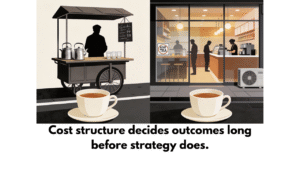 Cost Structure Is Destiny
 The Attention Economy Trade: Who Really Makes Money When Global Stars Visit India
Pingback: FII–DII Decoded: The Real Reason Markets Move (And It’s Not What You Think) - Dalal Street Lens