
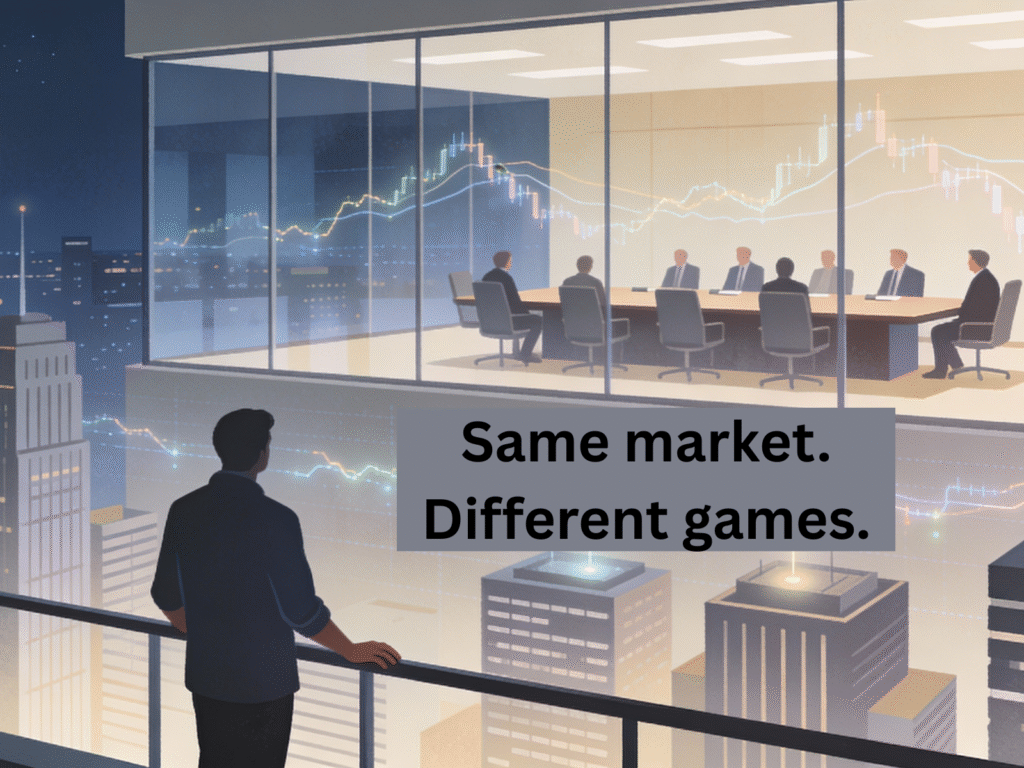
Why this comparison of Retail Investors vs Institutional Investors confuses more than it clarifies
At some point in every investor’s journey, a quiet doubt appears: Am I at a disadvantage because I’m not a professional?
It’s a reasonable question. Institutional investors manage vast sums of money, employ research teams, build sophisticated models, and speak directly with company management. Retail investors, in contrast, usually operate alone, piecing together understanding from annual reports, experience, and observation. On the surface, the imbalance feels obvious.
And yet, when you step back and look at outcomes over long stretches of time, that assumption begins to wobble.
If institutions are so well equipped, why do so many struggle to beat simple market indices over time? And if retail investors are truly disadvantaged, why do a small number quietly do well by doing things that look almost unimpressive?
This article exists because that tension deserves a clear explanation, not a motivational one.
The problem with the comparison itself
Most writing around retail investors vs institutional investors treats them as competitors in the same race. The discussion usually drifts toward access, fees, scale, and information. By the end, the reader is better informed, but not meaningfully clearer about how to behave.
The flaw lies in assuming both groups are playing the same game under the same rules.
They are not.
Institutional investors operate inside systems designed to minimise embarrassment before they maximise returns. Their decisions are shaped not only by markets, but by committees, clients, benchmarks, quarterly reviews, and career risk. A fund manager is judged less on whether an idea is eventually right and more on whether it looks reasonable at every point along the way.
Retail investors do not face this structure. Their struggle comes from a different place altogether.
How size quietly shapes behaviour
One of the least discussed differences between retail and institutional investors is the effect of scale. Managing large sums sounds like an advantage, but it carries limitations that rarely show up in neat comparisons.
Large capital cannot move quietly. It cannot build positions slowly without drawing attention. It cannot exit without affecting price. It cannot meaningfully invest in small or emerging companies without liquidity becoming a constraint. By the time a business is large and liquid enough for institutional money to enter comfortably, it is often already well understood.
This does not imply institutions are slow or careless. It simply reflects arithmetic.
Retail investors, by contrast, operate below this threshold. Their capital is small enough to be flexible, unnoticed, and patient. They can hold positions that do not yet matter to anyone else. This is not a superior skill. It is a structural condition.
Most retail investors never consciously recognise this as an advantage, which is why they surrender it so easily.
Time as a structural difference, not a virtue
Institutional capital is always on a clock. Performance is measured quarterly, reviewed annually, and compared continuously. Even funds that describe themselves as long-term must regularly justify periods of inactivity or discomfort. Silence becomes professionally expensive.
Retail capital does not carry that burden. A retail investor can buy a stock and do nothing for two years without having to explain that decision to anyone. There is no benchmark report arriving every quarter, no client asking why nothing happened.
In theory, this freedom is immense.
In practice, many retail investors recreate the same pressures voluntarily. They monitor prices obsessively, judge themselves daily against indices, and treat inactivity as a mistake. In trying to behave professionally, they adopt constraints that professionals themselves would gladly escape.
Where Peter Lynch’s thinking still fits
Peter Lynch’s ideas are often remembered through slogans, but their deeper value lies elsewhere. He understood that institutions are not defeated by ignorance, but by structure.
When Lynch spoke about buying what you know, he was pointing toward how ideas originate. Changes in consumer behaviour usually appear in daily life before they show up in earnings calls or spreadsheets. Institutions are trained to respond to formal information. Retail investors live closer to informal signals.
There is also a subtler difference that rarely gets discussed. Institutions are built to respond to filings, guidance, and measurable events. Retail investors notice shifts in behaviour first — which products quietly replace older ones, which services stop needing discounts, which brands no longer need to explain themselves. Academic research later formalises this difference, but investors feel it long before they measure it.
This does not remove the need for analysis. It explains why insight often arrives earlier in lived experience than in models.
Why institutions still underperform, statistically
Over long periods, this structural reality shows up clearly in data. SPIVA scorecards across global markets consistently show that a majority of actively managed equity funds underperform their benchmarks over 10–15 year horizons, even before accounting for the psychological cost of staying invested through cycles.
This persistent underperformance is not a failure of intelligence. It reflects the friction created by fees, turnover, benchmark awareness, and the need to remain conventionally acceptable at all times. Institutions must optimise for survival as businesses, not just for investment outcomes.
Retail investors do not face this trade-off. Their failure comes from somewhere else.
Why retail investors struggle despite having freedom
If retail investors genuinely possess flexibility, patience, and the ability to ignore noise, the obvious question follows: why do most still struggle?
The irony is that retail investors often fail not because they lack tools, but because they voluntarily adopt constraints they do not need. Frequent monitoring shortens time horizons. Shortened horizons amplify emotional reactions. Emotional reactions increase trading. Increased trading quietly transfers returns away through costs and mistakes.
None of this is imposed. It is chosen, often without being noticed.
Over time, the advantage of freedom erodes, replaced by behaviour that looks disciplined but is actually reactive.
A changing market, acknowledged honestly
It would be dishonest to pretend the market has not evolved. Retail participation today is far higher than it was a decade ago, and in certain phases retail flows now influence prices rather than merely reacting to them. Technology has lowered barriers, increased speed, and amplified collective behavior.
This has not removed institutional advantages, but it has blurred some older assumptions. Influence today is more distributed, and the boundary between retail and institutional behaviour is less rigid than it once was.
Recognizing this does not weaken the argument. It strengthens it by keeping it grounded in the present.
Understanding your place in the market
The most useful outcome of comparing retail and institutional investors is not deciding who is superior. It is understanding the game you are actually playing.
Institutions are constrained by size, scrutiny, and reputation. Retail investors are constrained by emotion, impatience, and self-doubt. Institutions struggle to be early. Retail investors struggle to stay still.
Once this becomes clear, many confusions resolve themselves. The question shifts from whether you can beat professionals to whether your behaviour aligns with the freedoms you already possess.
At some point, every investor has to decide whether they want to feel informed, or be effective. The market rewards the second more often than the first.
A quieter conclusion
Retail investors do not succeed by becoming more institutional. Institutions do not fail because they lack intelligence.
They succeed or fail for very different reasons.
Understanding this does not guarantee better returns. Markets offer no such assurances. But it does offer something more durable: clarity about where your real advantages and real risks actually lie.
For many investors, that clarity alone is enough to change how they think, how they act, and how much noise they choose to ignore.
And that is usually where better outcomes begin.
Harsh is the creator of Dalal Street Lens, where he writes about investing, market behaviour, and financial psychology in a clear and easy way. He shares insights based on personal experiences, observations, and years of learning how real investors think and make decisions.
Harsh focuses on simplifying complex financial ideas so readers can build better judgment without hype or predictions.
You can reach him at imharshbhojwani@gmail.com
More from Dalal Street Lens
 Most Investors Misread Accent Microcell. This Is the Real Business.
 Costco Business Model Explained: Why Costco Feels Different the Moment You Walk In
 McDonald’s Business Model Explained: Why It’s Not Really About Burgers
 Jesse Livermore Lessons
 Karnataka Bank Earnings Call Analysis – November 2025
 How Nassim Taleb’s Trading Philosophy Changed the Way I Look at Confidence in Markets
 Second Order Thinking in Investing: Four Decisions I Had to Learn the Hard Way
 Cost Structure Is Destiny
 The Attention Economy Trade: Who Really Makes Money When Global Stars Visit India
 India’s Data Centre Supercycle: The Simplest Explanation of Colo, Cloud and AI Infrastructure