
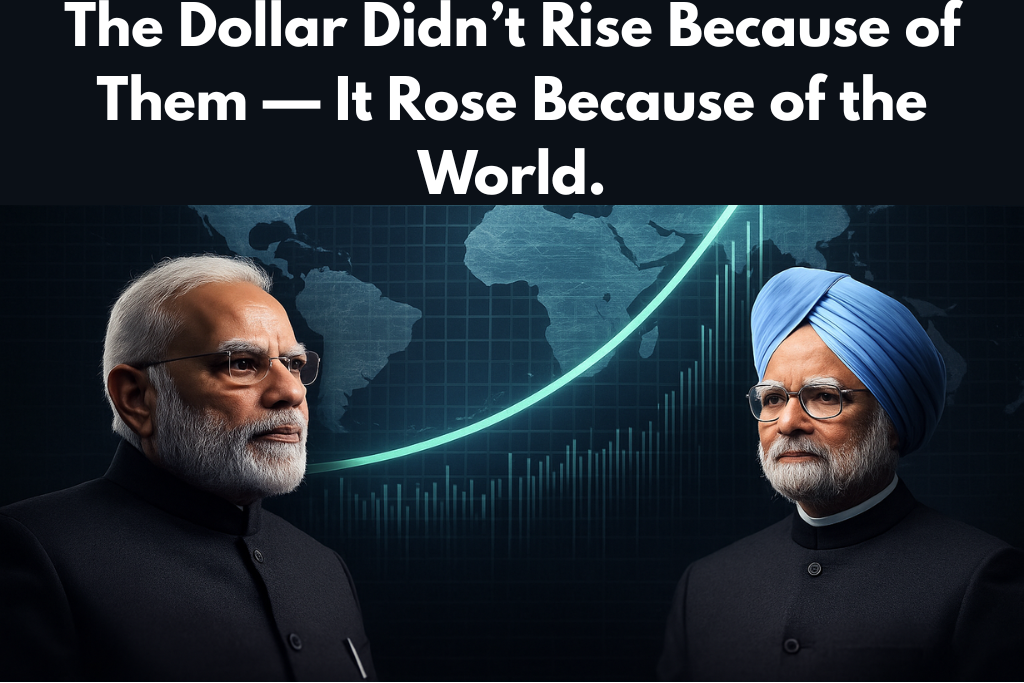
Whenever the rupee weakens against the dollar, an intense wave of noise grips India. Television debates turn dramatic, social media becomes polarized, and political leaders on both sides make strong statements. One side claims the rupee falling means the government has failed, while the other side blames previous policies. But the truth is far more complex and far less political. The strength of the US dollar has almost nothing to do with which party is in power in India. It is determined by global economic forces far bigger than domestic politics, and understanding this reality is essential if we want a mature conversation about the rupee.
A currency does not work like a college mark sheet where a higher score means better performance. A strong or weak exchange rate does not measure the success or failure of a government as directly as people assume. A currency reflects global capital flows, inflation differences, interest rate cycles across nations, trade balances, and financial stability. And in this global game, the US dollar plays a role unlike any other currency.
The dollar is the world’s safe-haven asset. It is the currency investors run to during global uncertainty. It dominates global trade, global borrowing, commodity pricing, and even central bank reserves. This gives the dollar a unique advantage. When the US Federal Reserve increases interest rates sharply, global money naturally flows toward the dollar because investors get better returns with lower risk. This movement happens irrespective of which party is ruling India. During the Fed’s aggressive rate hikes after 2022, currencies of even the most powerful economies tumbled. The Japanese yen fell to multi-decade lows. The euro weakened heavily. The British pound struggled. The Chinese yuan fell despite its controlled regime. Korea, Indonesia, Australia, South Africa, Canada — almost every major currency weakened. India was not an exception. It was simply part of the global trend.
This is why blaming the rupee’s movement on Modi or Congress is misleading. No Indian prime minister controls US interest rates, global inflation, international investor sentiment, or geopolitical tensions. When global investors pull money out of riskier markets and move it into the US, the dollar strengthens everywhere, not only in India. The rupee’s movement is the result of a global tide, not a domestic error.
India’s own structural realities also play a crucial role. India is a net importer and must spend billions of dollars every year to buy essential items like crude oil, natural gas, electronics, machinery, defence equipment, and semiconductor components. Almost all these imports are priced in dollars. This creates a constant and unavoidable demand for USD. Even if India doubled its import duties, it would still need oil, chips, and machinery. Duties cannot reduce essential imports without pushing inflation sky-high. That is why the idea that India can simply fix the rupee by taxing imports more is impractical.
Another factor that shapes currency movement is inflation. India’s long-term inflation is higher than America’s. If India’s inflation averages around five percent while the US averages around two percent, then over the long term, the rupee must adjust downward to maintain export competitiveness. This is known as the real effective exchange rate, or REER. Even RBI research repeatedly shows that the rupee is often overvalued relative to other emerging markets. A slow, predictable depreciation keeps Indian goods competitive abroad. Without this adjustment, exports would become expensive and foreign buyers would shift to cheaper producers like China, Vietnam, or Bangladesh.
This brings us to a crucial but rarely discussed point. A slightly weaker rupee is not a sign of weakness. It is a strategic advantage for an economy trying to expand exports. China built its export empire by keeping its currency deliberately undervalued for decades. Japan kept its yen weak to support its manufacturing dominance. South Korea and Taiwan followed similar paths. For export-driven economies, a strong currency is a disadvantage because it makes their products costlier in the world market. India is trying to become a manufacturing and export powerhouse through initiatives like Make in India and PLI schemes, and during this stage of transformation, a mildly depreciating rupee actually supports the strategy.
If the rupee suddenly became very strong, say back to seventy per dollar, the consequences would be severe. Exporters would lose competitiveness overnight. IT and service companies would earn fewer rupees per dollar of revenue. Textile firms, automobile exporters, pharmaceutical manufacturers, and engineering companies would all face losses. Cheap imports would flood the market and destroy domestic industries. Jobs would be lost, factories would slow down, and the trade deficit would widen. A strong currency often feels good emotionally because it makes foreign travel cheaper, but it can damage a developing economy that is still building its manufacturing base.
Media narratives make this worse. Television channels prefer simplified stories because they are easier to sell. “Rupee falls, government fails” or “Rupee rises, government succeeds” is an easy headline. It triggers emotion, creates debate, and attracts attention. But it hides the actual economics. A currency does not strengthen out of pride, nor does it weaken out of shame. It moves according to global liquidity, interest rate differentials, large investor flows, and structural trade patterns.
Historically, the rupee has always adjusted to global cycles. It fell during the 1991 crisis due to oil shock and low reserves. It fell again during the 2013 taper tantrum when the US hinted at tightening monetary policy. These were not government-specific failures. These were instances where global financial waves hit India’s shores. The difference now is that India has much stronger forex reserves, far better macroeconomic stability, and a more resilient financial system. This is why even during massive global stress, the rupee weakens slowly and in an orderly fashion, instead of collapsing like currencies in Pakistan, Sri Lanka, Turkey, or Argentina.
If India truly wants a stronger rupee in the long run, the path is not through emotional demands or political blame. It is through structural transformation. India must become a major exporter. It must reduce dependence on crude oil by investing in renewable energy, electric mobility, and domestic exploration. It must build semiconductor capabilities to reduce import dependency. Logistics costs must fall from fourteen percent of GDP to China’s eight percent. Free trade agreements need to be signed strategically. Manufacturing must scale up so that India exports not only services but also world-class products in electronics, machinery, chemicals, and automobiles.
When India becomes a trade surplus nation, the rupee will naturally strengthen. This will not require government announcements or political debates. It will happen because the fundamentals will demand it. A strong currency is a long-term outcome of economic strength, not a short-term symbol of political pride.
The debate about the rupee should therefore shift from blaming governments to understanding economics. The rupee does not weaken because of Modi, and it does not strengthen because of Congress, or vice versa. It weakens when the dollar becomes strong globally. It adjusts when inflation differentials demand it. It moves according to India’s long-term structural position in global trade. And it responds to the monetary decisions of the US Federal Reserve far more than the decisions of the Indian government.
The truth is simple yet powerful. Currencies are tools, not trophies. A nation’s strength is not measured by how many rupees make a dollar, but by how productive its industries are, how strong its exports are, how stable its financial system is, and how skilfully it navigates global economic tides. India is becoming stronger, but this strength may not immediately show in the exchange rate. It shows in resilience, in stability, in industrial capacity, and in rising global relevance.
If India continues its journey toward becoming an export-driven, innovative, energy-secure, high-value manufacturing nation, the rupee will eventually reflect that strength. But until that transformation is complete, expecting the rupee to behave like the currencies of rich, surplus economies is unrealistic. Before becoming strong on paper, a currency needs the foundation of a strong and competitive economy behind it. India is building that foundation, step by step.
If you liked this blog, you might enjoy my previous one as well:
👉 Why Are Countries Buying Gold… and Why India Is Doing It Faster?
Harsh is the creator of Dalal Street Lens, where he writes about investing, market behaviour, and financial psychology in a clear and easy way. He shares insights based on personal experiences, observations, and years of learning how real investors think and make decisions.
Harsh focuses on simplifying complex financial ideas so readers can build better judgment without hype or predictions.
You can reach him at imharshbhojwani@gmail.com
More from Dalal Street Lens
 Most Investors Misread Accent Microcell. This Is the Real Business.
 Costco Business Model Explained: Why Costco Feels Different the Moment You Walk In
 McDonald’s Business Model Explained: Why It’s Not Really About Burgers
 Jesse Livermore Lessons
 Karnataka Bank Earnings Call Analysis – November 2025
 How Nassim Taleb’s Trading Philosophy Changed the Way I Look at Confidence in Markets
 Retail Investors vs Institutional Investors
 Second Order Thinking in Investing: Four Decisions I Had to Learn the Hard Way
 Cost Structure Is Destiny
 The Attention Economy Trade: Who Really Makes Money When Global Stars Visit India
Pingback: Shanti Gold International: Business Model, Moat, Margins, Cash Flow & True Valuation Explained - Dalal Street Lens
Like your view, came from reddit.✌️