
Most investors assume that Warren Buffett and Charlie Munger understand every business they touch. But the truth is far more interesting—they ignore most businesses, simply because they don’t understand them well enough. Their entire philosophy rests on a simple idea: you don’t have to be an expert in everything. You only have to be very clear about the few things you truly understand.
This clarity becomes especially visible when they talk about the kinds of businesses they love, the ones they avoid, and the ones they regret. Buffett’s 2007 letter to shareholders captures this thinking beautifully, and when explained through Munger’s no-nonsense style, it becomes even easier for any investor—beginner or experienced—to learn from.
At the heart of their philosophy is a basic requirement: they invest only in businesses they understand. But “understanding” for them doesn’t mean mastering technical details or being able to run the company themselves. It simply means they can clearly see how the business makes money, why customers choose it, why those choices will continue for many years, and what might threaten it. If they can’t answer those questions confidently, they walk away. It’s surprisingly simple, and incredibly effective.
What truly sets the great businesses apart for Buffett and Munger is something they call a moat—a protective advantage that keeps competitors from attacking the business successfully. A moat could be a loved brand like Coca-Cola, a cost advantage like Costco, or the scale advantage of companies like Visa. A good moat makes the business stronger over time. A weak or temporary moat eventually collapses, and investors lose money. Their rule is just as simple: if a business has a moat that lasts, they’re interested. If not, they step aside.
Some moats are easy to spot. People choose Coca-Cola because they love the brand. They rarely switch from Microsoft Office because doing so is inconvenient. Google becomes stronger as more people use it, thanks to network effects. These moats are visible in daily life, even before you look at financial statements. And that’s exactly how Buffett and Munger prefer it—simple businesses with obvious advantages that don’t require complicated explanations.
To understand what a great business looks like, Buffett often uses the example of See’s Candy, which Berkshire bought in 1972. See’s didn’t grow very fast, nor was its industry exciting. But it had one of the strongest moats in consumer goods: customers bought See’s not just for the chocolate, but for the emotional value attached to it. It needed very little extra capital to expand, but it consistently generated huge cash flows. Over decades, See’s produced over a billion dollars in profit while requiring almost no reinvestment. For Buffett and Munger, that’s a dream business.
Not every business behaves like See’s. FlightSafety, another Berkshire company, is excellent at what it does, but it constantly needs more capital to grow because new flight simulators are expensive. It earns solid returns, but it doesn’t gush cash the way See’s does. This difference helps investors understand why some businesses are great, while others are only good.
And then there are the businesses that Buffett calls gruesome—the ones that grow fast, need massive capital, and still struggle to make money. Airlines have historically been the best example. They attracted investors with their growth potential, but competition and high operating costs made consistent profits almost impossible. Buffett himself invested in an airline once, regretted it, and openly called it a mistake. This honesty helps demonstrate that even the world’s best investors go wrong when they ignore their own principles.
In fact, Buffett has openly discussed his mistakes so others can learn from them. He almost skipped buying See’s Candy over a small price difference. He turned down a television station that later made over a billion dollars. And in one of his worst decisions, he bought Dexter Shoes using Berkshire stock—only for the business to collapse later. That one mistake cost Berkshire billions. These stories remind every investor that even the smartest people make errors, but the key is learning from them.
The most important lesson from Buffett and Munger is that good investing is not about predicting the future or chasing hot trends. It is about understanding what makes a business special, whether that strength can last, and whether you are paying a sensible price for it. A moat isn’t just a fancy word—it’s the core reason a business survives competition.
Investors can identify moats by asking simple questions:
Why do customers prefer this business?
Why can’t another company copy this easily?
What keeps customers loyal?
And if someone gave a new competitor billions of dollars, could they realistically catch up?
If the honest answer is no, then the business probably has a real moat.
That’s what Buffett and Munger really look for. Not complexity. Not excitement. Not the next big thing. Just simple, enduring advantages that make a business strong year after year.
And for any investor starting their journey, that mindset is worth more than any stock tip.
More from Dalal Street Lens
 Most Investors Misread Accent Microcell. This Is the Real Business.
 Costco Business Model Explained: Why Costco Feels Different the Moment You Walk In
 McDonald’s Business Model Explained: Why It’s Not Really About Burgers
 Jesse Livermore Lessons
 Karnataka Bank Earnings Call Analysis – November 2025
 How Nassim Taleb’s Trading Philosophy Changed the Way I Look at Confidence in Markets
 Retail Investors vs Institutional Investors
 Second Order Thinking in Investing: Four Decisions I Had to Learn the Hard Way
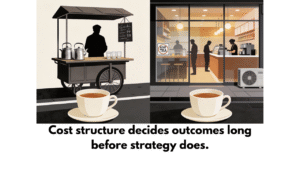 Cost Structure Is Destiny
 The Attention Economy Trade: Who Really Makes Money When Global Stars Visit India
Pingback: The Complete Guide to Relative Strength the William O’Neil Way - dalalstreetlens.in