
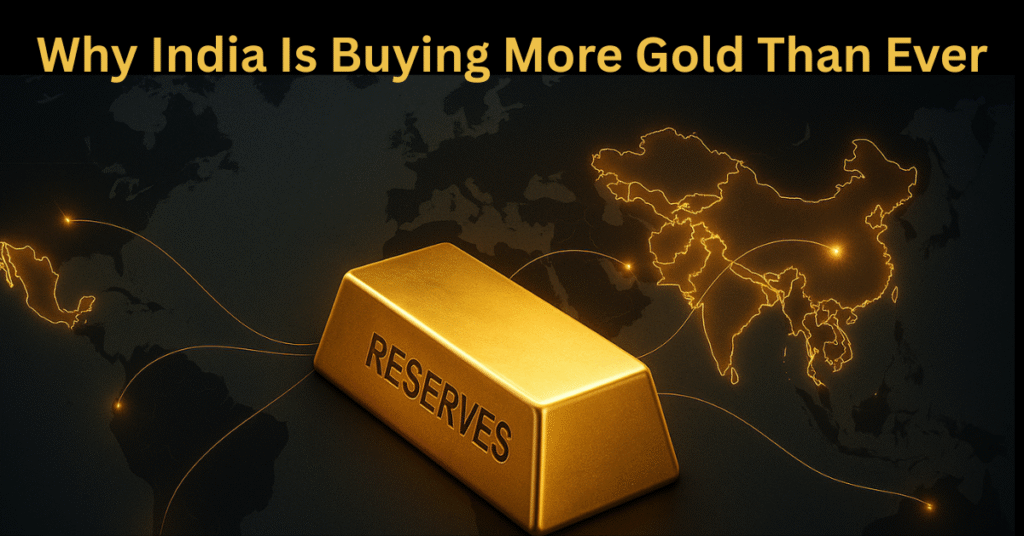
Gold has been on a relentless rise.
People are asking the same question everywhere:
“Gold itna tez kaise bhaag raha hai?” (Why did it shoot up so fast?)
Most assume it’s weddings, inflation, jewellers, or traders. But this time the reason is far bigger, far deeper, and far more serious.
Gold is rallying because governments—not retail investors—are buying it at the fastest pace in modern history.
When central banks move together, they’re not reacting to noise. They’re reacting to global shifts that ordinary people don’t see yet.
This blog explains exactly what changed, why it matters, and why India is quietly preparing faster than most nations.
The Gold Rally Has a New Driver: Governments
In earlier decades, gold moved because of sentiment, inflation, or seasonal buying. Today’s rally, however, is driven by something entirely different: central banks are hoarding gold at record speed.
Countries like China, Russia, Turkey, UAE, and India have been loading up tones of gold, month after month, year after year. This is unprecedented. Central banks are slow, conservative, and deeply calculated. They don’t chase assets—they prepare for shocks. When all of them start buying gold simultaneously, it signals one thing:
The world is entering a new era, and countries want insurance.
Not against inflation, but against a changing global order.
The Moment Global Trust Broke
The turning point arrived in February 2022. Russia invaded Ukraine. The U.S. and Europe responded not by sending troops but by freezing Russia’s foreign reserves. Overnight, a major nation discovered that its own money—kept safely in Western banks for decades—could disappear with a political decision.
This event changed the psychology of global finance.
It was a shockwave that travelled quietly across capitals around the world.
Countries realised that the global financial system is not neutral. It can be used as a weapon. And suddenly, the question became:
“If it happened to Russia… could it happen to us someday?”
This wasn’t about supporting Russia or opposing the West. It was about recognising a truth—if your assets sit in another country’s system, you don’t fully control them.
And so began the spree of gold buying.
The Hidden Risks Countries Are Preparing For (But Ordinary People Don’t See)
Countries are not panicking. They are preparing. Preparing for risks that don’t show up on TV debates, but silently shape the next decade.
Financial Weaponisation
The freezing of Russia’s reserves proved that money held abroad can be blocked. Foreign currency isn’t just economics anymore—it’s foreign policy. Nations now want assets that cannot be sanctioned, frozen, or digitally locked.
Gold is the only asset that fits that description.
Currency Fragmentation
The dollar is still the king, but it is no longer the only currency. Countries are signing deals in yuan, rupees, dirhams, euros—trying to reduce dependency on any single system. This creates a world where multiple “mini-currency zones” exist.
In such uncertainty, gold becomes the neutral anchor.
Supply-Chain Fragility
COVID, the chip shortage, the Ukraine war, Red Sea disruptions—every crisis revealed how fragile global supply chains truly are. One port shutdown or geopolitical incident can halt medicines, semiconductors, food, oil, or fertilisers.
Countries need strong safety reserves, and gold provides liquidity during chaos.
Geopolitical Blocs Forming
The world is quietly splitting:
- U.S.–Europe–Japan
- China–Russia
- Gulf neutrals (UAE–Saudi–Qatar)
This isn’t a Cold War, but it is a clear fragmentation. Nations don’t trust the system the way they did 20 years ago. In such a divided environment, gold has no enemy, ally, or politics.
It’s the ultimate neutral asset.
Black Swan Shocks
Cyberattacks, shipping blockades, sudden wars, banking glitches—any of these could disrupt global trade or payments. Governments know one shock can ripple across currencies and markets.
Gold is insurance against unpredictable events.
Loss of Trust Between Nations
For 30 years, the world trusted that global rules would hold. But after 2022, that trust has faded. Countries fear not each other—but the fragility of the system itself.
When trust goes down, gold goes up.
All these risks combine into a single conclusion:
Gold is the one asset every country trusts when nothing else feels stable.
Who’s Buying the Most Gold—and Why
It’s not just troubled countries. It’s not just emerging markets. Even stable, wealthy nations are buying. But here’s a quick, simple breakdown of the major gold accumulators:
Russia
Heavily sanctioned, frozen out of Western banking systems. Needs sanction-proof reserves.
China
Wants global currency influence and insurance against U.S. pressure. Accumulating quietly for years.
Turkey
Uses gold to stabilize inflation and currency swings.
UAE & Gulf Nations
Playing neutral. Diversifying reserves. Building independence from Western financial dominance.
India
The most interesting case—not buying out of fear, but out of strategy.
Why India Is Buying Gold Faster Than Most Nations
India’s gold accumulation is deliberate, measured, and deeply strategic.
India is repatriating its gold from abroad.
For decades, India stored a portion of its gold in the Bank of England. Now RBI is bringing chunks of that gold back to Indian soil. Not because the UK is hostile, but because sovereignty matters in a fractured world.
India is steadily increasing reserves.
Every few months, India adds more gold—small but consistent. India is building a long-term shield, not reacting to panic.
India is preparing for a multipolar world.
Not fully aligned with the U.S.
Not reliant on China.
Not dependent on Russia.
India wants optionality—freedom to move in any direction. Gold gives that.
India recognises currency risk is rising.
With CBDCs, contested currencies, and global blocs, the financial landscape is shifting. Gold provides stability.
India is reading global signals correctly.
When central banks buy gold aggressively, it’s not noise—it’s a structural shift. India is acting early and acting smart.
What This Means for the Ordinary Indian
This isn’t just global politics. It’s personal.
The ripple effects hit your job, your savings, and your investments.
Jobs
A fragmented world boosts:
- manufacturing
- defence production
- electronics
- logistics
- AI-driven services
India’s positioning in all these sectors is improving, creating new opportunities.
Money
Expect:
- more currency volatility
- inflation spikes during shocks
- rise of digital rupee
- global uncertainty
Gold becomes a small but meaningful part of personal security.
Investments
A wise, long-term Indian investor should consider:
- 5–15% gold as financial insurance
- high-quality Indian companies (banks, IT, consumer, infra)
- emerging sectors: defence, renewables, electronics, energy storage
- avoiding over-leveraged, hype-driven plays
India will likely outperform over the next decade because it sits at the centre of global power shifts.
India’s Rare Strategic Advantage
India is in a unique position in a divided world:
- Cheap energy from Russia
- Advanced tech from U.S. and Japan
- Investment from UAE and Saudi
- Manufacturing gains due to China+1 shift
- Neutral diplomacy giving it leverage everywhere
Few countries can navigate all blocs at once.
India can—and is.
Gold buying is only one part of this larger strategy of sovereignty and resilience.
Final Thoughts — Gold Didn’t Rise by Accident
Gold didn’t rally because of weddings or festivals.
It rallied because the world is preparing for a future where:
- trust is fragile,
- power is shifting,
- currencies are competing,
- systems can be weaponised, and
- globalisation is no longer guaranteed.
Governments see what ordinary people cannot.
They prepare early.
India is doing the same—quietly, steadily, smartly.
And as the world enters its most uncertain decade in 30 years, gold becomes more than an asset.
It becomes a signal.
A signal that the world is changing.
A signal that nations want sovereignty.
And a signal that individuals should start preparing too.
If you liked this blog, you might enjoy my previous one as well:
👉 Three Numbers That Reveal a Company’s True Character
Harsh is the creator of Dalal Street Lens, where he writes about investing, market behaviour, and financial psychology in a clear and easy way. He shares insights based on personal experiences, observations, and years of learning how real investors think and make decisions.
Harsh focuses on simplifying complex financial ideas so readers can build better judgment without hype or predictions.
You can reach him at imharshbhojwani@gmail.com
More from Dalal Street Lens
 Most Investors Misread Accent Microcell. This Is the Real Business.
 Costco Business Model Explained: Why Costco Feels Different the Moment You Walk In
 McDonald’s Business Model Explained: Why It’s Not Really About Burgers
 Jesse Livermore Lessons
 Karnataka Bank Earnings Call Analysis – November 2025
 How Nassim Taleb’s Trading Philosophy Changed the Way I Look at Confidence in Markets
 Retail Investors vs Institutional Investors
 Second Order Thinking in Investing: Four Decisions I Had to Learn the Hard Way
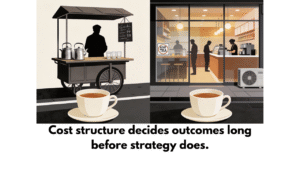 Cost Structure Is Destiny
 The Attention Economy Trade: Who Really Makes Money When Global Stars Visit India
Pingback: Strong USD Is Not a Modi Issue or a Congress Issue — It’s Global - Dalal Street Lens